

Time:2026-03-18
The landscape of commercial architecture is shifting. As energy codes become more stringent and labor costs for electrical installations skyrocket, traditional wired systems are being phased out. Enter wireless lighting control: the most scalable, cost-effective, and intelligent way to manage illumination in 2026.
Whether you are a lighting wholesaler, a commercial electrical contractor, or an OEM manufacturer looking for a reliable partner, understanding the nuances of a wireless lighting control system is critical for staying competitive. In this guide, we explore how wireless technology is revolutionizing spaces from high-bay warehouses to modern office complexes.
In the rapidly evolving landscape of commercial architecture, a wireless lighting control system has transitioned from a high-end luxury to an indispensable strategic asset. Here is why industry leaders are making the switch:
The primary catalyst for this shift is the drastic reduction in capital expenditure. By eliminating miles of complex low-voltage communication wiring—such as traditional DALI or 0-10V hardwired loops—facility managers can:
Slash installation labor costs by up to 70%.
Make smart technology accessible for budget-conscious retrofits.
Avoid invasive re-wiring that was previously cost-prohibitive.
For large-scale commercial projects, the ultimate driver is unparalleled flexibility.
Legacy Wired Systems: Any structural change, such as moving a partition wall, once required expensive electrical re-routing.
Wireless Infrastructure: The building becomes "liquid." You can effortlessly re-group sensors, dimmers, and switches via a smartphone app or cloud interface.
This concept of "software-defined lighting" serves as the digital backbone of the modern smart building, allowing the environment to adapt to human needs in real-time without touching a single wire.
The integration of Networked Lighting Controls (NLC) provides a foundation for long-term energy efficiency. In the North American market, being DLC NLC listed is the recognized gold standard for performance and high-value utility rebate eligibility.
The LumiEasy Advantage: Our systems utilize advanced Bluetooth Mesh protocols to create a robust, self-healing fabric of connectivity. Every node communicates with its neighbors, ensuring there is no single point of failure—providing the industrial-grade reliability that wholesalers and contractors demand for mission-critical facilities.

Building a robust, enterprise-level network requires far more than consumer-grade "smart bulbs." To ensure industrial reliability, you need high-specification hardware engineered to withstand the rigors of 24/7 continuous operation in demanding environments.
The wireless light controller serves as the localized intelligence of the entire system. Typically integrated directly into or mounted onto the LED fixture, this critical component acts as the primary receiver for commands. It processes signals from motion sensors or wall switches to execute precise dimming or ON/OFF actions. Leading-edge controllers, such as those provided by LumiEasy, are designed for global versatility—supporting universal voltages from 120-277V up to high-voltage 347-480V for heavy industrial sites. These units provide granular control through advanced PWM or 0-10V dimming protocols, ensuring flicker-free performance and maximum energy savings.
While automated "set-and-forget" lighting is the ultimate goal, manual override remains a non-negotiable requirement for occupant comfort. A wireless remote control light switch empowers tenants to manually adjust brightness or instantly trigger complex "scenes"—such as a "Presentation Mode" for boardrooms or "Safety Dimming" for warehouses—all without the prohibitive cost of running communication wires behind the drywall.
In the world of facility upgrades, the speed of deployment is the ultimate selling point. When implementing remote control lights wireless setups in older buildings, the labor savings are astronomical. Electrical contractors can rapidly swap out inefficient HID or fluorescent fixtures for modern LED high bays equipped with integrated wireless nodes. This transition instantly transforms a "dumb" warehouse into a data-driven smart facility with zero new control wiring, minimizing downtime and maximizing the return on investment (ROI).
When researching high-performance solutions, procurement officers and electrical engineers frequently evaluate Lutron wireless lighting control systems, such as the Vive or Athena platforms. Lutron has undoubtedly set a formidable high bar for reliability and premium brand recognition within the North American market. However, as the global supply chain evolves, savvy wholesalers and OEMs are increasingly shifting their focus toward open-protocol standards like Bluetooth Mesh and Zigbee to avoid the limitations of "walled garden" ecosystems.
While a Lutron wireless lighting control setup offers localized excellence, it often locks the facility manager into a closed proprietary environment where future expansions are dictated by a single vendor's pricing and roadmap. In sharp contrast, LumiEasy’s solutions are built on the foundation of global interoperability, providing a more versatile and future-proof alternative.
Extreme Cost-Efficiency: We provide industrial-grade, high-end performance—including advanced dimming and scheduling—at a fraction of the heavy "brand-name" markup associated with traditional market leaders.
Tailored OEM/ODM Customization: Unlike rigid large corporations, we specialize in private-labeling and tailored hardware modifications. This allows wholesalers to build their own brand identity and maintain unique market positioning without the overhead of R&D.
Streamlined Commissioning: Our signature 7-step smartphone-based commissioning process is meticulously designed for field electricians. This eliminates the need for expensive, specialized software engineers, drastically reducing the "Time-to-Light" for any commercial project.
By choosing an open-protocol partner like LumiEasy, you gain the technical sophistication of a networked system without the restrictive long-term costs of proprietary hardware.
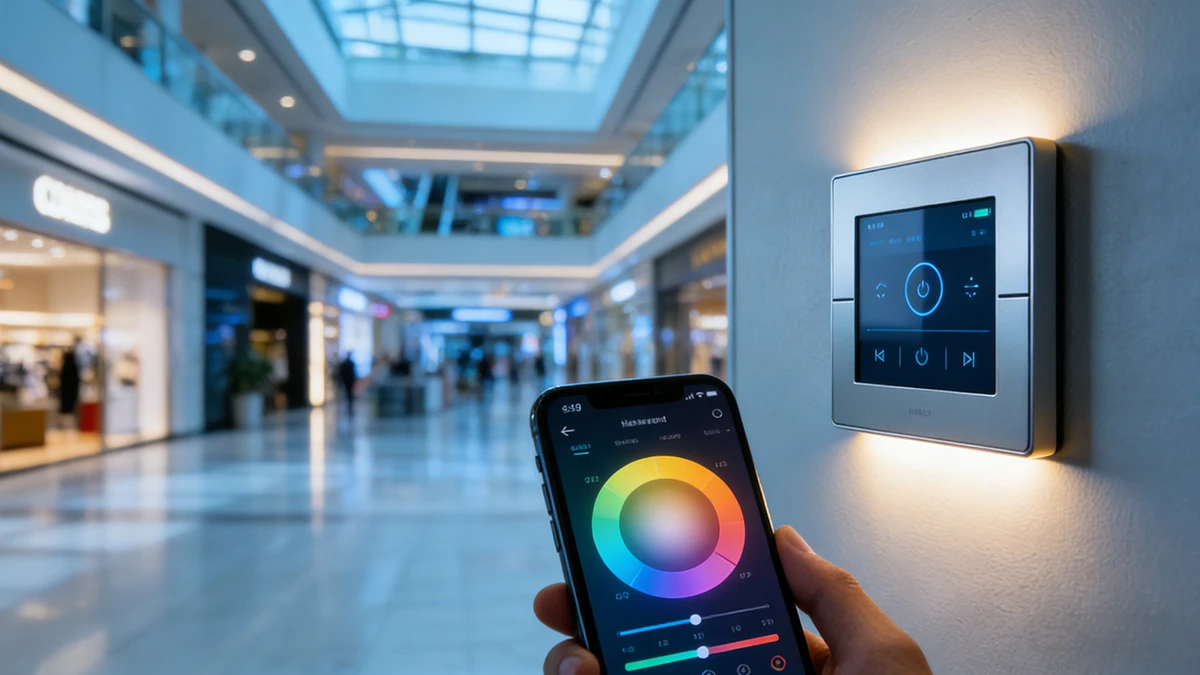
In the era of smart building technology, effective wireless light control has evolved into a sophisticated, data-driven discipline that transcends simple ON/OFF functionality. For modern facility managers, it is a powerful tool for granular energy management and operational oversight. By leveraging real-time data, commercial spaces can significantly reduce their carbon footprint while simultaneously enhancing occupant comfort and safety.
In large-scale wireless lighting control commercial applications, "zoning" is the cornerstone of efficient management. Wireless zone lighting control empowers users to logically group fixtures by their specific functional requirements, rather than being restricted by physical circuit wiring. Consider these high-efficiency scenarios:
Zone A (Window Perimeters): Implements advanced daylight harvesting to automatically dim artificial lights when natural sunlight is sufficient, maximizing energy savings during daylight hours.
Zone B (Internal Corridors): Operates on a specialized occupancy logic, maintaining a 20% safety dimming level to eliminate dark spots, while instantly ramping to 100% brightness only when motion is detected.
Zone C (Loading Docks): Synchronizes with a strict astronomical time-clock, ensuring exterior lighting perfectly aligns with local sunrise and sunset schedules regardless of the season.
A groundbreaking shift in the industry is the rise of battery-free wireless lighting interfaces. Utilizing cutting-edge energy-harvesting technology, these switches convert the kinetic energy of a finger press into a wireless signal. This revolutionary "press-to-power" mechanism requires zero batteries and zero wires, effectively eliminating the logistical nightmare of maintaining thousands of battery-powered devices across a massive 500,000-square-foot facility. By removing the battery replacement cycle, LumiEasy helps wholesalers provide a truly "install-and-forget" solution for the most demanding industrial clients.
The ultimate success and long-term reliability of a wireless lighting control installation depend heavily on a meticulous initial site survey and the structural integrity of the established mesh network. To ensure industrial-grade performance that meets the expectations of high-stakes commercial projects, installers must adhere to several technical pillars:
Strategic Node Density: Maintaining a strong, redundant signal requires precise placement. You must ensure that controllers are positioned within the recommended range—typically 30 to 60 feet, depending on the building's internal partitions—to create a "dense mesh" where every device can find multiple communication paths.
Proactive Obstacle Mapping: In demanding industrial environments, specialized factors like heavy metal racking and reinforced concrete walls act as RF shields that can degrade signal quality. Utilizing a high-gain wireless light controller equipped with an external antenna is a proven strategy for penetrating these "metal forests," ensuring 100% connectivity even in high-interference zones.
Security-First Architecture: Modern commercial systems are part of a building's critical infrastructure. Therefore, implementing AES-128 bit encryption is a non-negotiable standard to prevent unauthorized access and protect the network's data integrity.
By following these best practices, LumiEasy ensures that every wireless light control deployment remains secure, scalable, and virtually maintenance-free for years to come.
Wireless lighting controls work by using Radio Frequency (RF) signals—such as Bluetooth Mesh, Zigbee, or proprietary sub-GHz frequencies—to send commands between devices. A sensor detects motion and sends a wireless packet to the wireless light controller, which then tells the LED driver to dim or brighten.
For commercial and industrial users, this is achieved through a Gateway. The gateway bridges the local wireless mesh network to the cloud. Through a secure web portal or mobile app, facility managers can monitor energy usage, change schedules, or troubleshoot fixtures from anywhere in the world.
Industrial spaces are the biggest beneficiaries of this tech. Because warehouses have high ceilings (30ft+), wiring sensors is incredibly expensive. Wireless systems allow for "Fixture-Level Lighting Control" (LLLC), where each light behaves independently based on its own occupancy sensor, maximizing energy savings by up to 80%.
The most common protocols include:
Bluetooth Mesh: Ideal for high-density, scalable commercial projects (the LumiEasy standard).
Zigbee: Common in residential and some commercial IoT.
Wi-Fi: High bandwidth but high power consumption; usually reserved for gateways.
Proprietary RF: Like Lutron's Clear Connect, known for high reliability but limited interoperability.
At LumiEasy, we understand the demands of the European and American markets. We are the first Chinese enterprise to pass NLC indoor and outdoor certification, proving that our quality meets the world's strictest efficiency and security standards.
Our Services for Wholesalers and OEMs:
OEM/ODM Manufacturing: We provide white-label sensors, controllers, and switches tailored to your brand's specifications.
Project Support: From lighting plans to commissioning guidance, we help you win more bids.
Compliance: All products are designed to meet UL, CE, and DLC requirements.
Are you ready to upgrade your lighting portfolio?[Contact LumiEasy today for a wholesale quote or a customized OEM proposal.]
【Contact us to get a free quote】
Related Articles
Wireless Lighting Control Systems for Commercial and Industrial Buildings


)
)
)
)

+86 15899791249

+86 755 2955 3313


Address: Huafeng No.1 Science and Technology Park, Sanwei, Bao'an District, Shenzhen, Guangdong, China.
