

Time:2026-07-02
Navigating the stringent landscape of international life safety codes is one of the most critical challenges facing commercial luminaire manufacturers, facility managers, and electrical engineers today. Ensuring full centralized emergency lighting monitoring system compliance is no longer just a technical upgrade; it is a legal imperative. Regulatory bodies across North America and Europe impose heavy penalties on facilities that fail to execute, log, and archive mandatory emergency readiness tests.
For factory-level OEMs and system integrators, developing or sourcing a code-compliant automated testing infrastructure can be a complex process. This comprehensive guide details the foundational engineering, networking, and legal frameworks required to achieve absolute compliance while maximizing operational efficiency through intelligent automation.
To establish a bulletproof centralized emergency lighting monitoring system compliance roadmap, engineering teams must first align with regional lifecycle safety mandates. Hand-written testing logs are rapidly being phased out by code enforcement officials in favor of digital, tamper-proof system records.
In the United States and Canada, the National Fire Protection Association (NFPA 101 Life Safety Code) outlines explicit guidelines for emergency illumination.
The 30-Day Functional Test: Emergency luminaires must be energized for a minimum of 30 seconds every month.
The Annual Full-Duration Test: Systems must sustain full illumination for at least 90 minutes on backup power to satisfy basic emergency powerpack duration requirements
Automated Data Logging: Section 7.9.3 allows for self-testing/automated equipment, provided the system automatically records test results and generates an unalterable compliance report.
Across Europe and the UK, EN 50172 specifies the testing and monitoring matrices for emergency escape lighting. The code dictates that a centralized system must continuously monitor the operational status of individual components and communicate failures instantly to a centralized control location.
Achieving absolute compliance requires a cohesive hardware-to-software relationship. A modern centralized infrastructure bridges the gap between raw luminaire hardware, emergency lighting power packs, and localized automation networks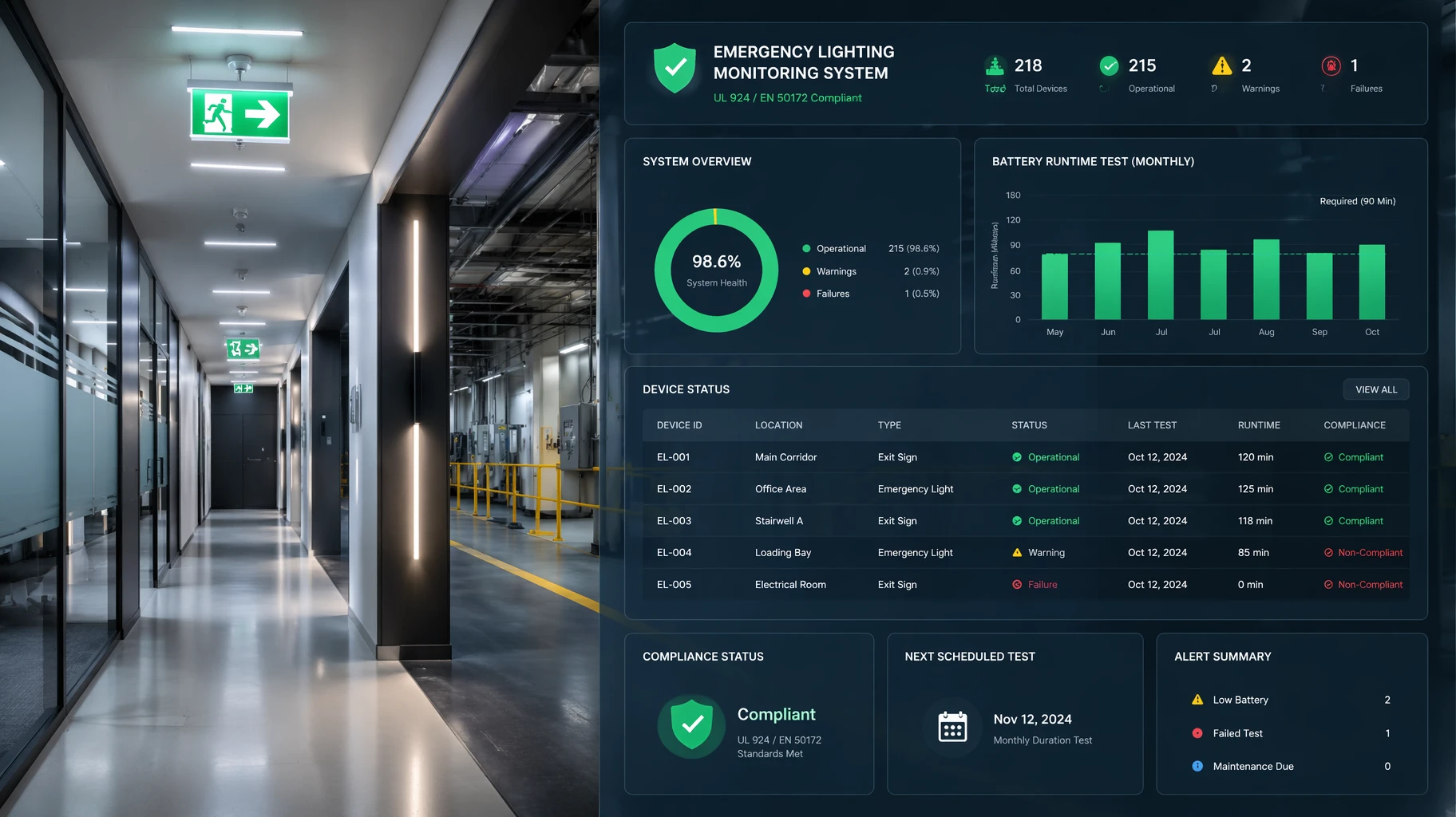
When designing system-level layouts, facilities typically choose between two primary hardware methodologies:
In this setup, each commercial fixture houses individual emergency lighting power packs
Commonly utilized in large-scale industrial manufacturing plants, a centralized inverter cabinet delivers alternative back-up emergency power over dedicated branch circuits. Here, the monitoring software tracks the total load metrics, individual circuit isolation breakers, and battery bank discharge curves dynamically during automated test cycles.
The table below highlights critical technical benchmarks that engineers must look for when configuring centralized safety architectures to satisfy commercial building codes.
| Technical Parameter | Compliance Requirement (UL 924 / EN 50172) | LumiEasy Integrated Feature | System-Level Benefit |
| Testing Automation | Automated monthly 30-sec functional & annual 90-min runtime execution. | Programmable scheduling engine via central management software | Eliminates manual labor; removes human error from compliance reporting. |
| Failure Detection | Lamp failures, battery disconnections, and charging circuit faults must be flagged within 24 hours. | Real-time bidirectional telemetry monitoring via digital D4i/DALI bus | Immediate pinpointing of faulty fixtures to speed up maintenance cycles. |
| Log Preservation | Historical test results must be preserved and accessible for at least 2 to 5 years. | Secure SQL local database backup with encrypted cloud synchronization. | Ready for instantaneous inspection by fire marshals and safety auditors. |
| Duration Target | Minimum 90 minutes continuous run-time under emergency load conditions | Intelligent battery cell balancing and thermal cutoff protection arrays. | Guarantees compliance with strict emergency powerpack duration requirements |
Designing a resilient topology requires deep familiarity with industrial communication physics. For a comprehensive overview of how automated architectures enhance overall facility protection and reduce operating costs, read our comprehensive industry analysis on
The foundational layer must be built on robust, noise-immune physical layers. DALI-2 (Digital Addressable Lighting Interface) stands out as an open-protocol favorite because it enables digital feedback loops from emergency ballasts. Line voltage lines should be accompanied by twisted-pair control lines to prevent external cross-talk.
To convert localized luminaire statuses into plant-wide data packets, a dedicated intelligent gateway is required. The gateway continuously polls individual fixture nodes for fault codes. It then translates these specialized low-level signals into standard high-level building automation protocols such as BACnet/IP, Modbus TCP, or secure MQTT streams.
For a step-by-step technical breakdown of wiring distances, node limits, and termination resistor sizing for emergency infrastructures, refer to our detailed
The apex of system compliance is the graphical user interface (GUI). The central lighting management software must give facility operators a clear, live layout view of the entire building footprint
Many factory clients mistakenly view safety compliance as a pure cost center. However, by selecting hardware from an agile smart lighting solutions provider, you can seamlessly combine life-safety infrastructure with regular energy-saving commercial smart lighting systems
Modern emergency luminaires can double as standard fixtures during normal operational states. By layering advanced smart sensors onto the same local control bus, the building gains advanced energy harvesting capabilities, such as automated motion detection and occupancy tracking.
During a main utility power loss, the centralized system immediately overrides standard smart sensor programming, forcing the emergency power packs to provide full illumination along the exit path regardless of local sensor states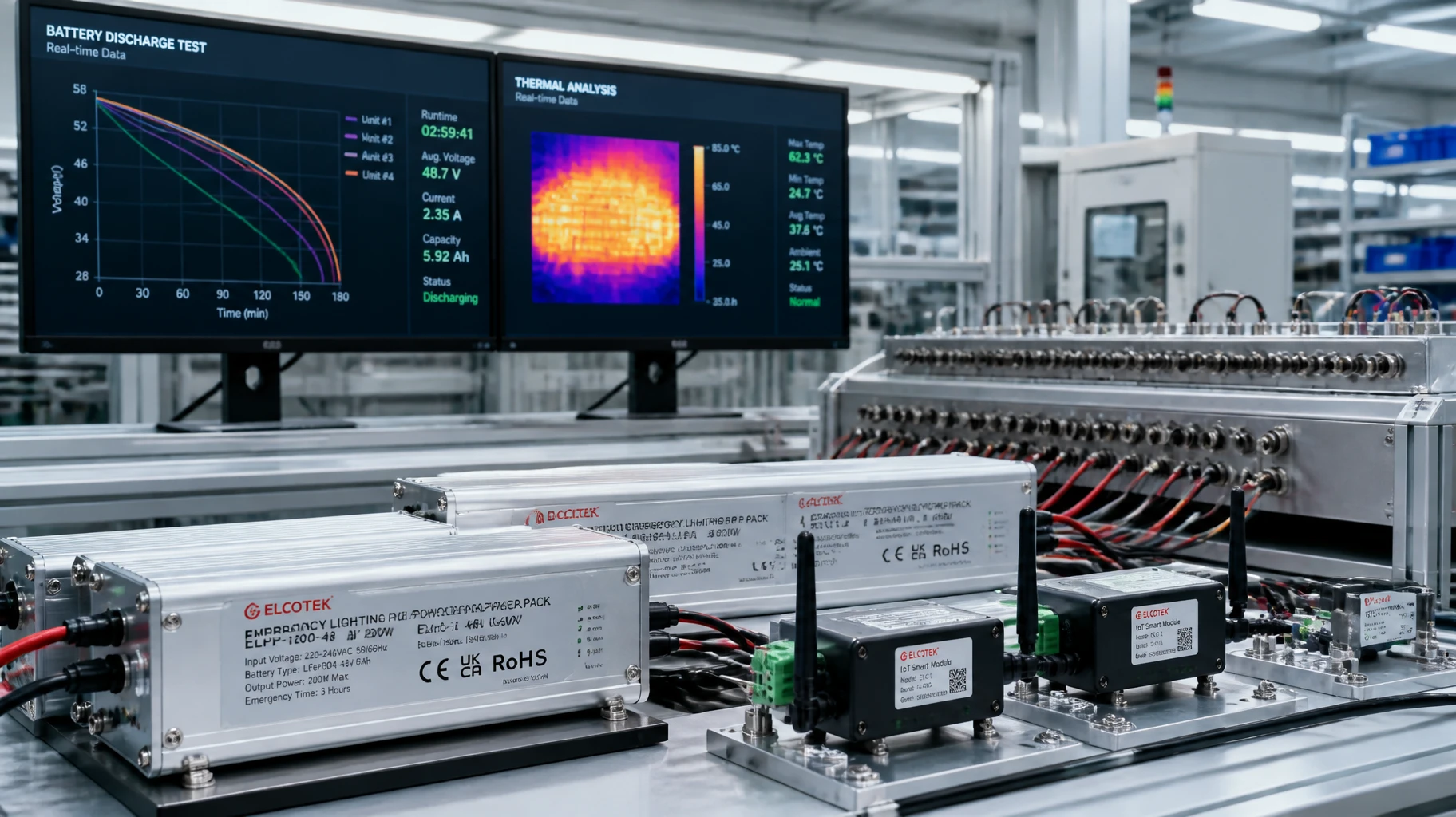
A1: A digital centralized system completely replaces manual labor by executing pre-programmed monthly and annual diagnostic tests automatically. The system logs all fixture performance variables, battery capacity curves, and system errors into a secure, permanent ledger that satisfies local fire marshal audit requirements instantly.
A2: Yes. LumiEasy engineered our industrial-grade emergency lighting power packs with highly modular, low-profile mechanical form factors
A3: The LumiEasy centralized architecture is built for total flexibility, supporting wired DALI/D4i networks alongside robust, wireless Bluetooth Mesh protocols
Securing international regulatory compliance does not have to be a multi-vendor bottleneck. By choosing a specialized engineering and manufacturing partner, your factory can seamlessly deploy fully integrated, certified safety control platforms that protect lives, pass fire marshal inspections, and lower facility management costs.
Do not risk building code violations or expensive field recalls. Let our dedicated team of IoT engineers help you specify, configure, and supply the ideal hardware architecture for your market requirements.


)
)
)
)

+86 15899791249

+86 755 2955 3313


Address: Huafeng No.1 Science and Technology Park, Sanwei, Bao'an District, Shenzhen, Guangdong, China.
