

Time:2026-07-09
The convergence of Information Technology (IT) and operational building automation has permanently reshaped the commercial illumination landscape. For low-voltage system integrators, network architects, and high-volume luminaire OEMs, implementing Power over Ethernet (PoE) coupled with Networked Lighting Controls (NLC) represents the pinnacle of sustainable enterprise infrastructure. By substituting rigid, high-voltage copper conduits with flexible, low-voltage structured cabling, modern enterprises realize immense savings in initial deployment budgets. However, migrating to an IP-centric architecture introduces highly specialized engineering parameters. Understanding the precise nlc poe lighting system installation requirements is paramount to avoiding signal attenuation, packet loss, or structural code violations during field deployment.
Transitioning manufacturing and integration processes to satisfy these high-power digital network demands requires strict compliance with IEEE electrical standards and low-voltage structured infrastructure design. This technical specification guide breaks down the core physics, routing constraints, and certification criteria required to execute a seamless, code-compliant commercial lighting deployment.
Traditional commercial building controls separate power distribution from behavioral control logic. In sharp contrast, a PoE-driven infrastructure unifies DC power delivery and high-speed bidirectional data communication over a single twisted-pair Ethernet cable (typically Category 6 or Cat6A).
By transitioning industrial assets to an aggregated PoE network layer, facility directors unlock structural operational efficiencies:
Simplified Low-Voltage Infrastructure: Eliminating specialized line-voltage conduits allows certified low-voltage technicians to safely execute 100% of the fixture routing, bypassing high-cost licensed electrical labor.
Granular IoT Telemetry Processing: Every connected node receives a native IPv6 address, unlocking native compatibility with central building management systems (BMS) and cloud analytical platforms without requiring protocol translation gateways.
Uncompromised System Safety: Operating within the Class 2 electrical boundary (under 60V DC) radically slashes the risk of electrical shock and structural fire hazards, accelerating regional building occupancy inspections.
To build a resilient poe networked lighting controls matrix, system designers must align their hardware selection with the latest IEEE 802.3 standards. Modern commercial LED luminaires require high-wattage thresholds to satisfy industrial lumen outputs.
Legacy PoE standards (802.3af/at) capped power delivery at 30W, which was insufficient for high-output commercial luminaires. Modern low-voltage grids utilize ieee 802.3bt power over ethernet architectures:
Type 3 PoE++: Delivers up to 60W at the switch port, ensuring approximately 51W of usable power reaches the luminaire after worst-case line resistance dissipation.
Type 4 PoE++: Delivers up to 90W at the switch port, guaranteeing up to 71.3W of direct DC injection to the intelligent LED driver node.
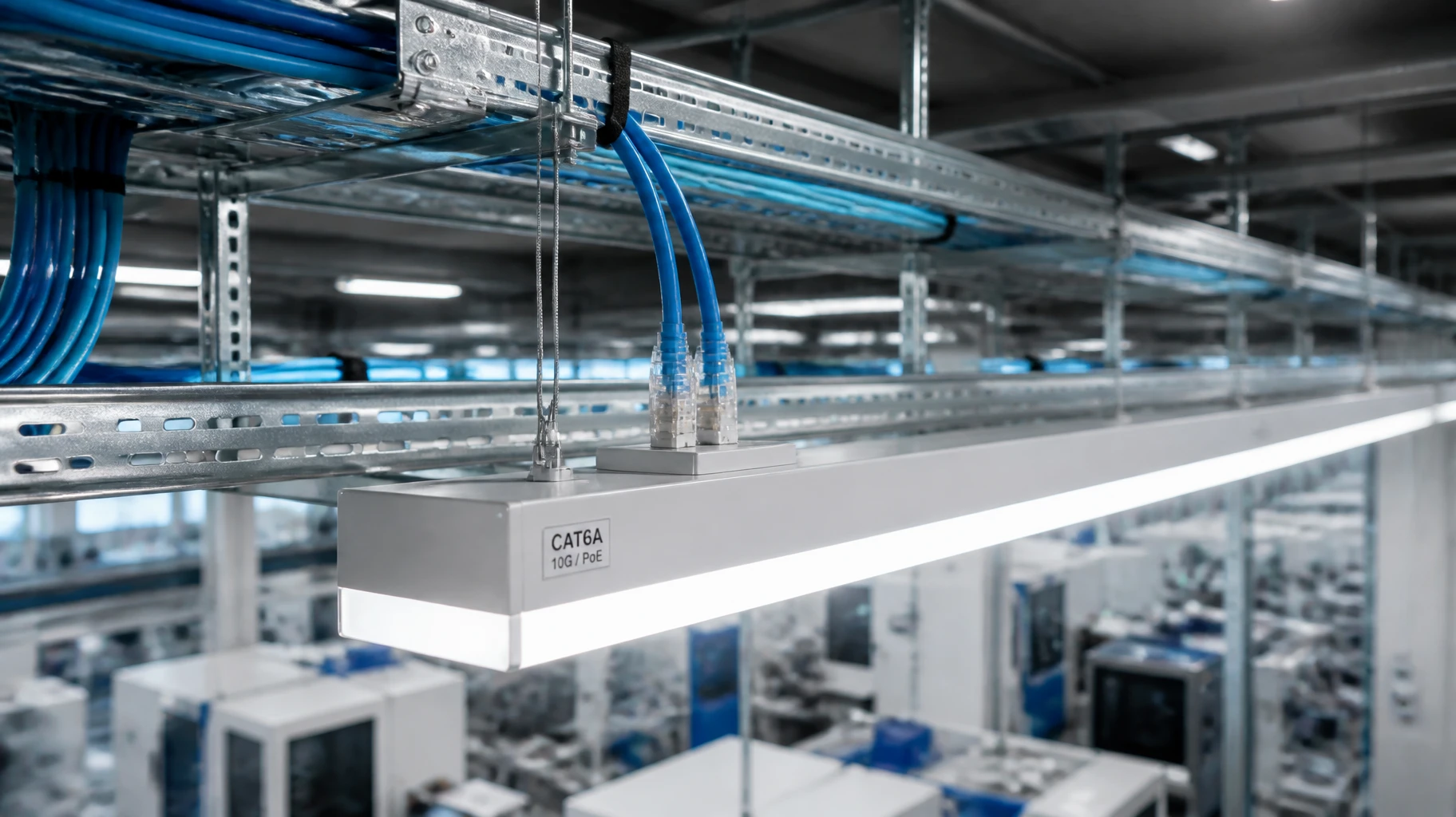
A non-negotiable physical metric governing Ethernet infrastructure is the maximum channel limitation of 100 meters (328 feet). This standard encompasses 90 meters of permanent solid-core horizontal copper cabling and a combined maximum of 10 meters of stranded patch cords. Attempting to stretch Cat6 runs past this boundary induces high loop resistance, precipitating sharp voltage drops and digital packet fragmentation that manifests as erratic flickering or complete luminaire drops during heavy network traffic cycles.
The table below highlights critical structured cabling benchmarks and environmental factors that installation crews must verify before deploying low-voltage smart components on the factory floor.
| Installation Parameter / Specification | Target Requirement (NLC 5.1 / TIA-568) | LumiEasy Native Hardware Integration | Field Engineering & Deployment Benefit |
| Conductor Gauge Size | Minimum 23 AWG solid bare copper (Cat6 / Cat6A). | Optimized RJ45 insulation displacement connectors (IDC). | Lowers internal DC line resistance; completely prevents critical voltage drop anomalies. |
| Cable Bundle Thermal Limits | Maximum bundle size of 24 lines under 90W load. | High thermal threshold low-voltage internal components. | Prevents heat accumulation inside closed plenums; safeguards jacket longevity. |
| Termination Standard | Strict adherence to ANSI/TIA-568 T568B wiring maps. | Factory-etched color-coded schematic guides on modular nodes. | Eliminates cross-talk and phase reversals; accelerates diagnostic line auditing. |
| Plenum Safety Rating | CMP (Plenum-rated) jacket compliance mandatory. | Enclosed fire-retardant industrial composite hardware shell. | Satisfies strict municipal smoke and fire-propagation commercial building codes. |
Mass-producing reliable low-voltage components requires moving far beyond basic circuit layouts. As a premier, innovation-focused smart lighting solutions provider, LumiEasy maintains dedicated digital validation laboratories equipped with advanced network analysis rigs and thermal profiling chambers to stress-test our hardware under real-world loads.
High-Power PoE++ LLDP Handshake Analysis: Our firmware deployment engineers test individual components using advanced network simulators to guarantee that our smart drivers execute flawless Link Layer Discovery Protocol (LLDP) data exchanges with major enterprise IT switches (such as Cisco, Aruba, and Netgear). This ensures precise 90W power allocation matching without port shutdown errors.
Closed-Plenum Thermal Bundle Saturation Testing: We bundle our devices alongside dense data cable arrays inside unventilated, high-heat testing environments exceeding 50°C. Continuous infrared monitoring ensures that internal silicon chipsets maintain peak electrical conversion efficiency without suffering from thermal throttling.
Deterministic Data Traffic Latency Auditing: We simulate massive industrial network architectures by running over 500 nodes on a single local network. Our testing monitors device grouping command response delays, proving that our devices maintain instantaneous, sub-30ms execution speeds during high-density network communication surges.
By deploying pre-validated components, modern facility managers can effortlessly integrate their advanced illumination nodes with scalable automation platforms. This strategic hardware selection drastically minimizes on-site installation risks. To learn more about how unified low-voltage hardware structures cut field labor expenses, read our specialized technical analysis on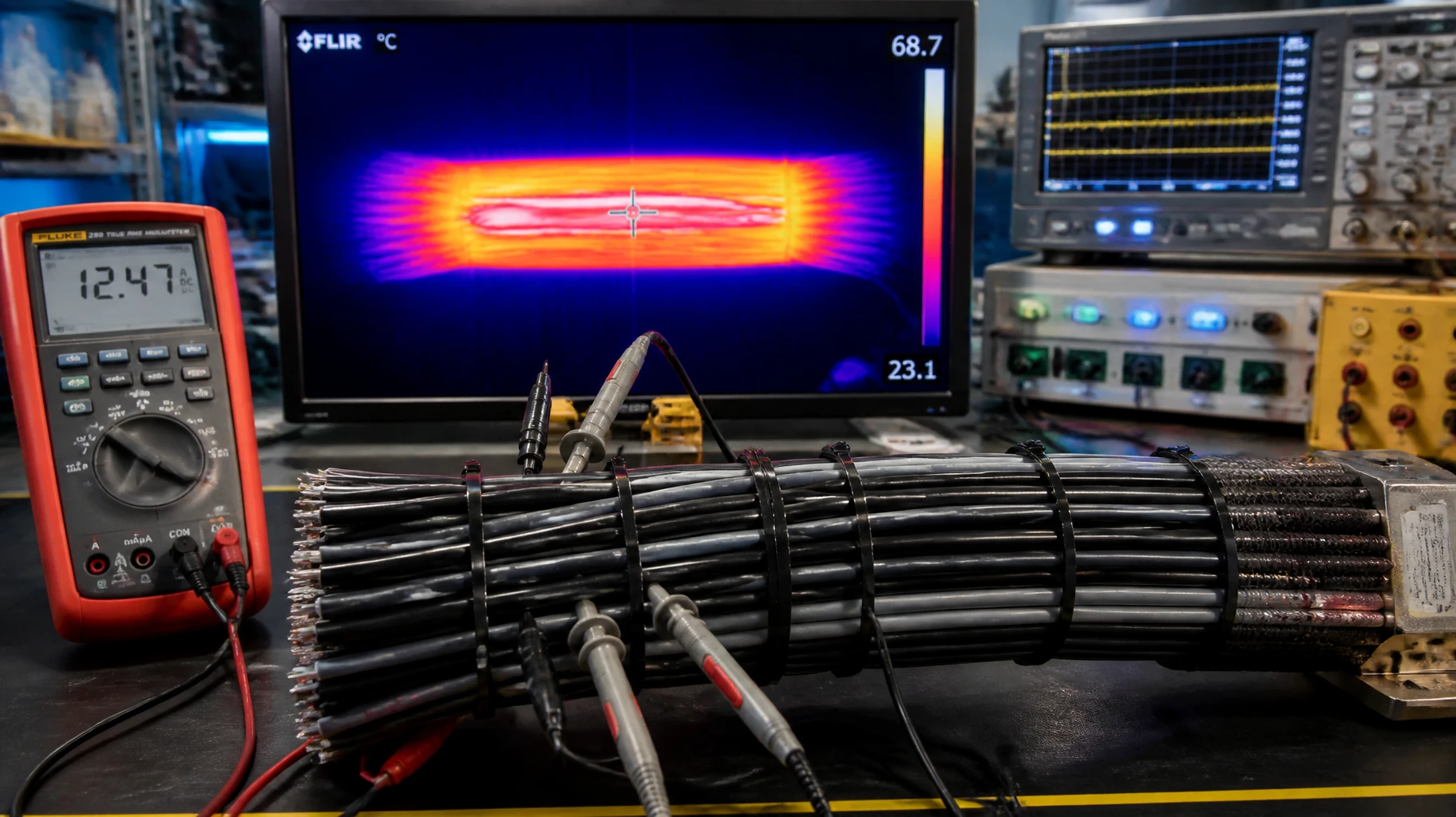
Deploying low voltage lighting installation infrastructures inside complex industrial environments require strict containment strategies to safeguard data transmission pathways from heavy industrial ambient noise.
High-voltage industrial motors, arc welders, and heavy machinery generate significant electromagnetic fields that can disrupt unshielded Ethernet data lines. Installation teams should maintain a minimum physical clearance of 12 inches (30 cm) from all high-voltage AC electrical lines. Where tight routing constraints force data and power lines to intersect, they must cross at a perfect 90-degree angle to minimize the induction of external network noise.
Standard commercial RJ45 connections easily fail when exposed to the continuous vibrations and airborne oils typical of heavy industrial production environments. Sourcing heavy-duty components prevents these costly operational issues. Incorporating robust hardware layouts preserves system uptime across demanding commercial settings. Discover how your business can optimize operational stability across demanding settings by examining our guide on
The final phase of satisfying the nlc poe lighting system installation requirements centers on the digital commissioning process. Because every element within a PoE lighting platform operates as an active IT asset, configuration shifts from manual wiring adjustments to structured network optimization.
Field deployment software automatically scans the local network switch ports to discover the distinct MAC addresses of newly installed sensors and LED nodes. Once mapped, the software provisions secure IP configurations and establishes unified lighting zones, daylight harvesting logic, and scheduling profiles. Because the control commands run directly over a high-speed Ethernet backbone, facility operators can implement granular luminaire level lighting control lllc configurations that capture maximum energy efficiency without requiring expensive proprietary hardware modules.
A1: The absolute physical distance limit is 100 meters (328 feet) using standard Category 6 solid copper lines. Exceeding this boundary induces high electrical resistance, causing severe voltage drops and communication packet loss that can destabilize smart components.
A2: LumiEasy manufactures advanced industrial-grade drivers equipped with smart LLDP negotiation firmware. This allows our devices to communicate directly with enterprise IT PoE switches to safely request and manage up to 90W of Type 4 Class 8 power over standard Ethernet cabling.
A3: Absolutely. The LumiEasy central software gateway translates raw IP-based network telemetry directly into standard industrial automation protocols such as BACnet/IP and Modbus TCP. This enables complete integration with pre-existing building management frameworks.
Transitioning your commercial product portfolio or industrial facility to a modern, IP-centric low-voltage environment shouldn't involve complex multi-vendor compatibility risks. By cooperating with a dedicated, engineering-first technology manufacturer like LumiEasy, your organization gains immediate access to durable, pre-vetted, and code-compliant PoE hardware engineered to integrate perfectly with advanced enterprise IT infrastructure. Protect your infrastructure investments, minimize field deployment expenses, and construct a future-proof building network that maximizes asset efficiency.
Don't let complex low-voltage wiring regulations slow down your next commercial property development. Contact our specialized network-illumination division today to analyze blueprint drawings, request certified testing evaluation hardware, and lock in volume factory pricing.


)
)
)
)

+86 15899791249

+86 755 2955 3313


Address: Huafeng No.1 Science and Technology Park, Sanwei, Bao'an District, Shenzhen, Guangdong, China.
