

Time:2026-09-08
As buildings become more connected, lighting systems are expected to support additional functions such as:
Occupancy-based control
Daylight harvesting
Energy monitoring
Remote management
Building automation integration
For these applications, DALI D4i certified luminaires provide a standardized foundation for intelligent lighting.
However, choosing a D4i luminaire requires more than checking whether a product description includes the term “D4i”.
A successful smart lighting project depends on several factors, including driver capability, sensor compatibility, commissioning efficiency, and future system integration.
This guide explains the key points lighting designers, OEMs, contractors, and facility managers should consider when selecting DALI D4i certified luminaires.
A DALI D4i certified luminaire uses D4i-enabled components to provide standardized digital communication, power capabilities, and luminaire data access.
Compared with traditional lighting systems, D4i enables luminaires to become more than simple light sources.
They can provide information and support intelligent control functions such as:
Operating hours
Energy-related data
Device status information
Sensor integration
Remote monitoring
For a detailed explanation of DALI D4i sensor-ready architecture, see:
DALI D4i Sensor Ready Interfaces: Smart Lighting Revolution
https://www.lumieasy.com/industry_trends/DALI-D4i-Sensor-Ready-Interfaces-Smart-Lighting-Revolution_395.html
For commercial projects, the important question is not only:
“Is this luminaire D4i certified?”
The more important question is:
“Can this luminaire support the complete smart lighting requirements of the project?”
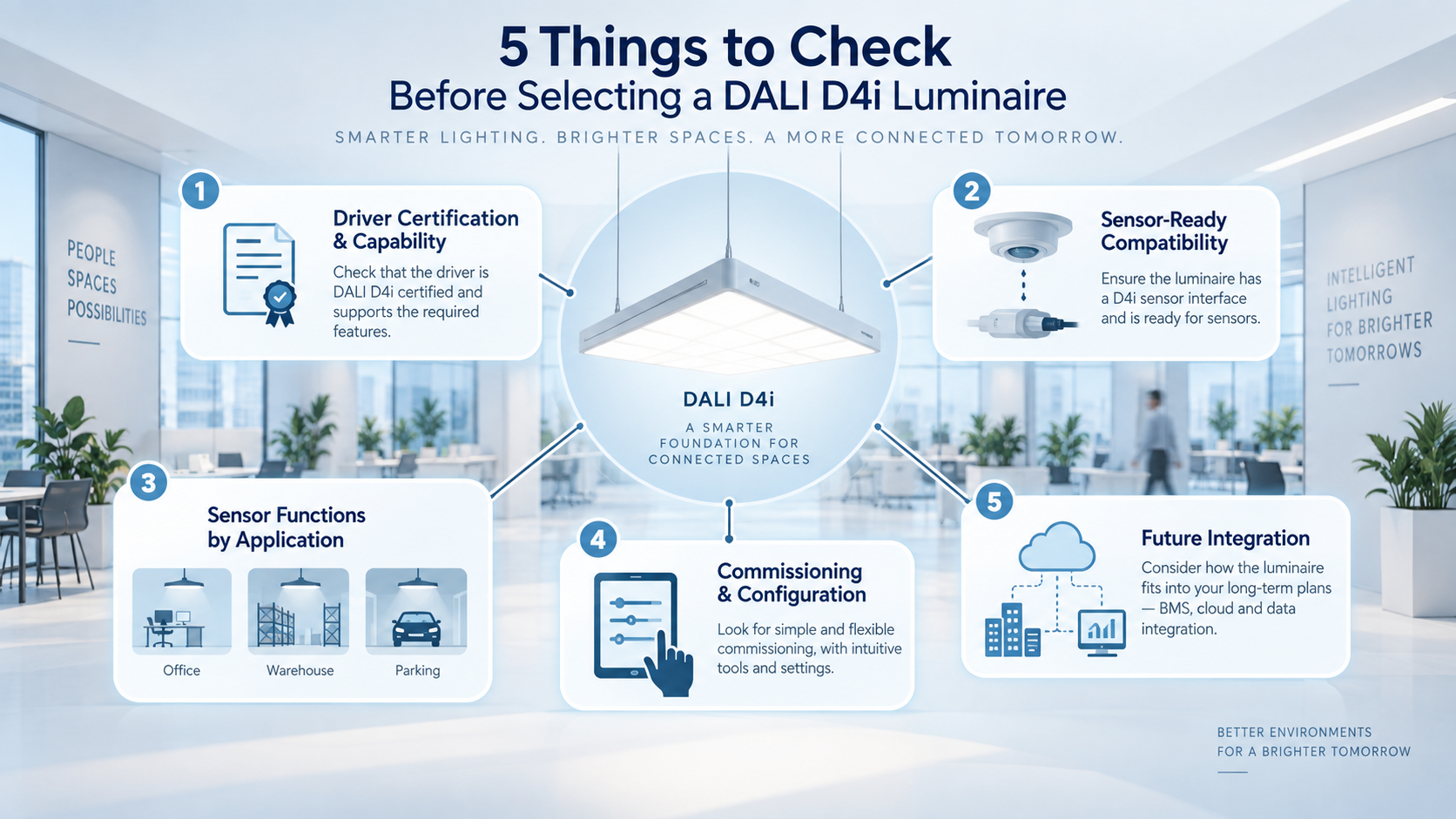
The LED driver is the foundation of a D4i luminaire.
A certified D4i driver should provide the required communication and data capabilities between the luminaire and external control devices.
Before selecting a product, check:
D4i certification status
Supported DALI functions
Available luminaire data
Compatibility with external control devices
A D4i driver should not only control light output but also support future intelligent functions.
For projects requiring detailed specification verification, commissioning requirements should also be considered during the selection stage.
Learn more:
DALI D4i Commissioning Specification Guide
https://www.lumieasy.com/DALI-D4i-Commissioning-Specification-Guide.html
A major advantage of DALI D4i lighting is the ability to connect sensors and control modules.
However, not every sensor-ready luminaire provides the same level of compatibility.
Project teams should evaluate three aspects:
Confirm:
Sensor mounting method
Interface type
Installation location
For Zhaga-D4i solutions, the standardized interface helps simplify sensor installation and future replacement.
Check:
Power availability
Voltage requirements
Device requirements
Verify:
DALI communication support
Data exchange capability
Control device compatibility
A sensor-ready luminaire should provide a reliable connection between the fixture, sensor, and lighting control system.
The right D4i luminaire depends on how the space is used.
Different commercial environments require different control strategies.
Common requirements:
Occupancy detection
Daylight harvesting
Automatic dimming
Example:
Near-window fixtures can reduce output when natural daylight increases, while maintaining comfortable working conditions.
Common requirements:
Motion detection
Zone-based control
High mounting height sensing
Lighting can automatically adjust based on activity areas, reducing unnecessary energy consumption.
Common requirements:
Vehicle or pedestrian detection
Adaptive brightness control
Scheduled operation
For these applications, sensor selection should be considered together with the luminaire design.
Explore LumiEasy smart lighting sensors:
https://www.lumieasy.com/product/
For large commercial projects, hardware installation is only one part of the process.
Commissioning can become a significant challenge when hundreds or thousands of luminaires need configuration.
Before selecting a D4i lighting solution, consider:
Device addressing
Group configuration
Parameter adjustment
System testing
Maintenance access
A well-designed smart lighting system should reduce onsite labor and simplify future adjustments.
This is especially important for contractors and system integrators managing large-scale installations.
LumiEasy provides smart lighting control solutions designed to simplify configuration and management for commercial projects.
Learn more:
https://www.lumieasy.com/system/
Commercial buildings often evolve after installation.
A lighting system that meets today's requirements may need additional capabilities in the future.
Before selecting a DALI D4i luminaire, consider whether the system can support:
Building management systems (BMS)
Energy monitoring
Remote management
Cloud-based operation
Future sensor upgrades
A future-ready lighting design helps avoid costly replacements when building requirements change.
DALI D4i is not the only approach for smart lighting.
Wireless lighting controls are also widely used, especially for retrofit projects.
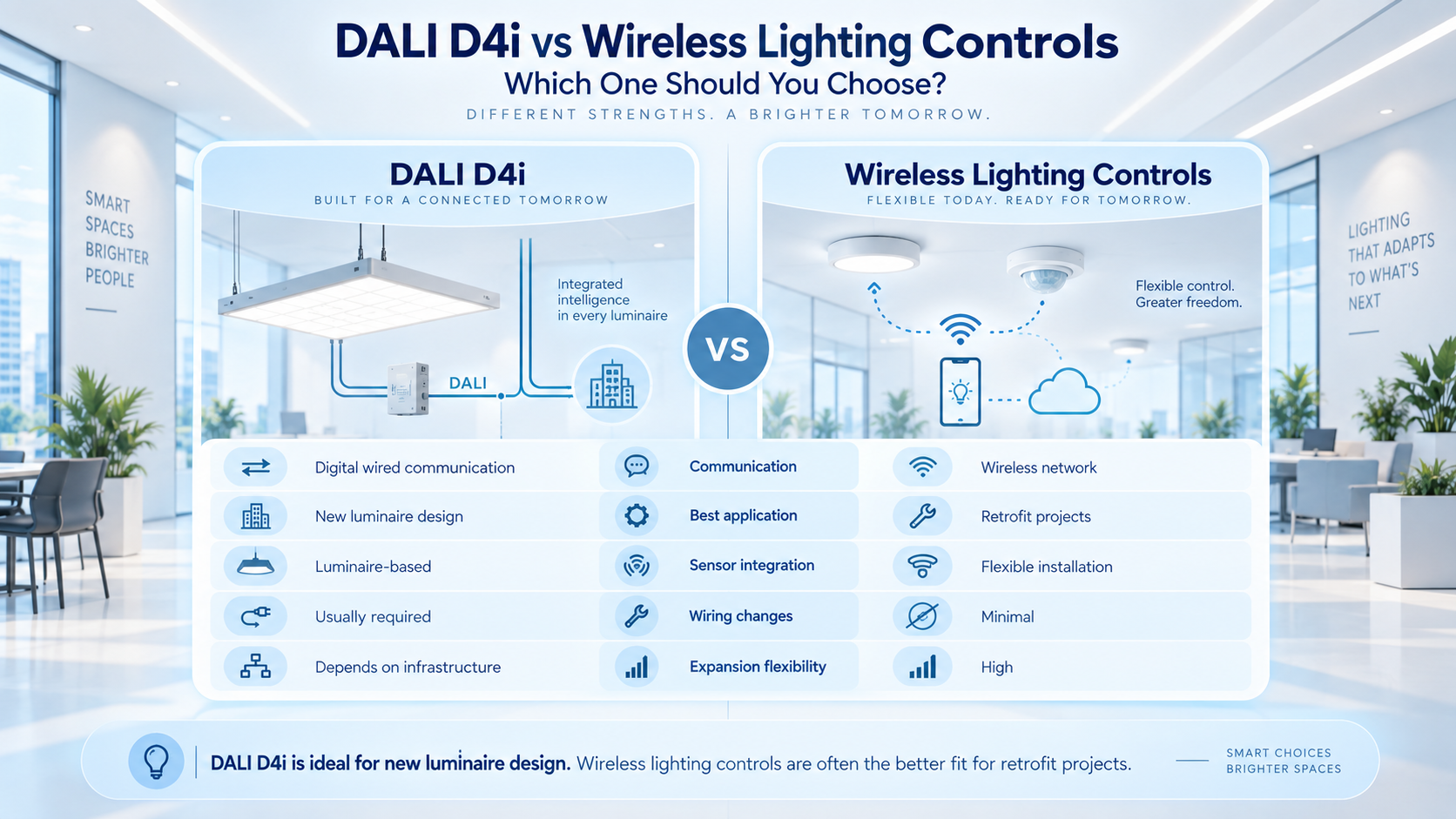
| DALI D4i | Wireless Lighting Controls | |
|---|---|---|
Communication | Digital wired communication | Wireless network |
Best application | New luminaire design | Retrofit projects |
Sensor integration | Luminaire-based | Flexible installation |
Wiring changes | Usually required | Minimal |
Expansion flexibility | Depends on infrastructure | High |
For new commercial luminaires, DALI D4i provides a standardized foundation for intelligent lighting.
For existing buildings where rewiring is difficult, wireless solutions can offer a more flexible upgrade path.
LumiEasy provides Bluetooth Mesh wireless lighting control solutions for commercial retrofit and smart building applications.
Learn more:
https://www.lumieasy.com/system/
DALI D4i luminaires are suitable for many commercial applications, including:
Support:
Occupancy-based control
Daylight harvesting
Energy optimization
Support:
Flexible lighting zones
Scene control
Better customer experience
Support:
Automated operation
Reduced energy waste
Maintenance visibility
Support:
Connected lighting systems
Data collection
Building automation integration
Selecting the right DALI D4i luminaire is the first step.
A complete smart lighting solution also requires:
Compatible sensors
Reliable control systems
Efficient commissioning
Easy management tools
LumiEasy provides smart lighting control solutions for commercial applications, including:
Smart lighting sensors
DALI D4i solutions
Wireless lighting controls
Remote configuration and management
By combining intelligent hardware and flexible control platforms, LumiEasy helps lighting professionals create systems that are easier to install, commission, and operate.
Explore LumiEasy solutions:
https://www.lumieasy.com/product/
A DALI D4i certified luminaire uses D4i-enabled components to provide standardized digital communication, data capabilities, and support for intelligent lighting applications.
No. Mechanical, electrical, and communication compatibility should be verified before selecting sensors and control devices.
D4i defines communication and data requirements, while Zhaga-D4i combines D4i with a standardized physical interface for sensor and module installation.
DALI D4i enables advanced lighting control, energy monitoring, diagnostics, and future smart building integration.


)
)
)
)

+86 15899791249

+86 755 2955 3313


Address: Huafeng No.1 Science and Technology Park, Sanwei, Bao'an District, Shenzhen, Guangdong, China.
