

Time:2025-12-31
Lighting is a foundational element of office environments, directly impacting employee productivity, visual comfort, and overall well-being. In modern workplaces, where diverse work modes (focus work, collaboration, remote work) coexist, traditional one-size-fits-all lighting systems can no longer meet dynamic needs. Office indoor lighting sensors emerge as a key solution, integrating occupancy detection, ambient light sensing, and smart control to deliver tailored illumination. By automatically adjusting lighting intensity, color temperature, and on/off status based on real-time office conditions, these sensors balance energy conservation with human-centric lighting needs. For facility managers, workplace designers, and business owners, adopting office indoor lighting sensors is a strategic step toward building sustainable, efficient, and employee-friendly office spaces. This article explores the core value, targeted office scenarios, implementation guidelines, and future trends of office indoor lighting sensors, highlighting their indispensable role in modern office optimization.
Traditional office lighting systems, reliant on manual switches, fixed timers, or uniform brightness settings, suffer from obvious inefficiencies and user experience flaws. A primary limitation is excessive energy waste: lights in unoccupied areas (such as empty meeting rooms, corridors, or unused workstations) often remain on for hours, with studies showing that unnecessary office lighting accounts for 20-30% of total office energy consumption. Fixed timers, another common solution, lack flexibility—they may turn off lights prematurely during overtime work or stay on idle during early office closures.
Another critical flaw is the failure to adapt to diverse work needs and natural light changes. Conventional lighting provides uniform brightness across all office areas, ignoring the varying requirements of different tasks: focused work (e.g., data analysis, design) requires high-brightness, cool-toned lighting, while collaboration or rest areas need soft, warm-toned illumination. Additionally, traditional systems cannot adjust to natural light fluctuations—resulting in overly bright spaces on sunny days or dim areas on cloudy days, which strains employees’ eyes and reduces productivity. These limitations underscore the necessity of office indoor lighting sensors to revolutionize office illumination.
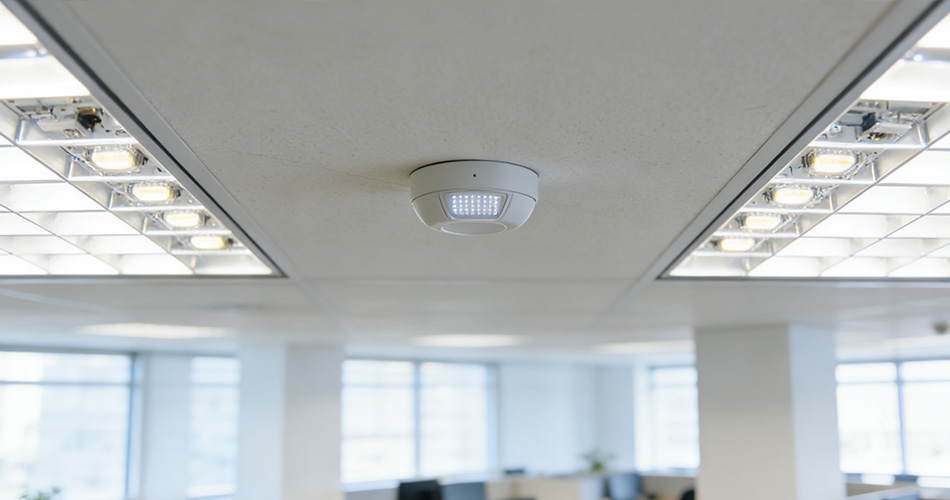
Office indoor lighting sensors redefine office lighting by delivering four key advantages tailored to workplace needs:
Precision energy conservation: By detecting occupancy and ambient light intensity in real time, office indoor lighting sensors ensure lights are only activated or adjusted when needed. They automatically turn off lights in unoccupied workstations, meeting rooms, or corridors, and dim artificial lighting when natural light is sufficient. This can reduce office lighting energy consumption by 35-45%, significantly lowering operational costs and supporting corporate sustainability goals.
Task-specific lighting adaptation: Advanced office indoor lighting sensors can adjust brightness and color temperature based on work tasks and areas. For example, they provide high-brightness (500-700 lux) and cool-toned (5000K-6500K) lighting in focus work zones, while switching to low-brightness (200-300 lux) and warm-toned (2700K-3500K) lighting in break areas or collaboration pods. This task-oriented adaptation enhances employee comfort and productivity.
Seamless integration with smart office ecosystems: These sensors integrate smoothly with other office smart systems, such as desk booking platforms, HVAC, and security systems. For instance, when an employee books a workstation via the office app, the corresponding office indoor lighting sensor activates the preset lighting mode; when the HVAC system adjusts temperature, the sensor coordinates to optimize lighting brightness, creating a unified intelligent office environment.
Data-driven lighting optimization: Office indoor lighting sensors collect real-time data on lighting usage, occupancy patterns, and energy consumption. Facility managers can use this data to identify underused areas, adjust lighting schedules, and refine sensor parameters. For example, if data shows a focus work zone is rarely used after 6 PM, the sensor can be set to dim earlier, further reducing energy waste.
Office indoor lighting sensors excel in diverse office environments with varying work modes and lighting needs, delivering unique value across different office zones:
Open Plan Office Areas: Open offices with shared workstations require flexible lighting. Office indoor lighting sensors detect individual workstation occupancy, turning on lights only when employees are present. They also adjust brightness based on natural light penetration (e.g., dimming lights near windows and brightening those in inner zones), ensuring uniform and comfortable illumination across the entire open area.
Private Office and Focus Rooms: Private offices and small focus rooms are used for concentrated work. Sensors here maintain high-brightness, cool-toned lighting during work hours and automatically dim or turn off lights when the space is unoccupied. They can also be linked to employee preferences, allowing personalized lighting settings (e.g., preferred brightness) to enhance work comfort.
Flexible Collaboration Zones: Modular collaboration zones (used for team discussions, brainstorming, or casual meetings) need adaptable lighting. Office indoor lighting sensors adjust based on occupancy density—brightening for large groups and dimming for small teams. They can also switch to warm-toned lighting to foster a relaxed collaboration atmosphere, improving team interaction efficiency.
24/7 Office and Night-Shift Zones: For offices with round-the-clock operations (e.g., IT support centers, financial service firms), sensors ensure appropriate lighting for night shifts while conserving energy. They maintain low-glare, eye-friendly lighting during nighttime hours to reduce employee fatigue and automatically adjust to morning light levels as the day begins.
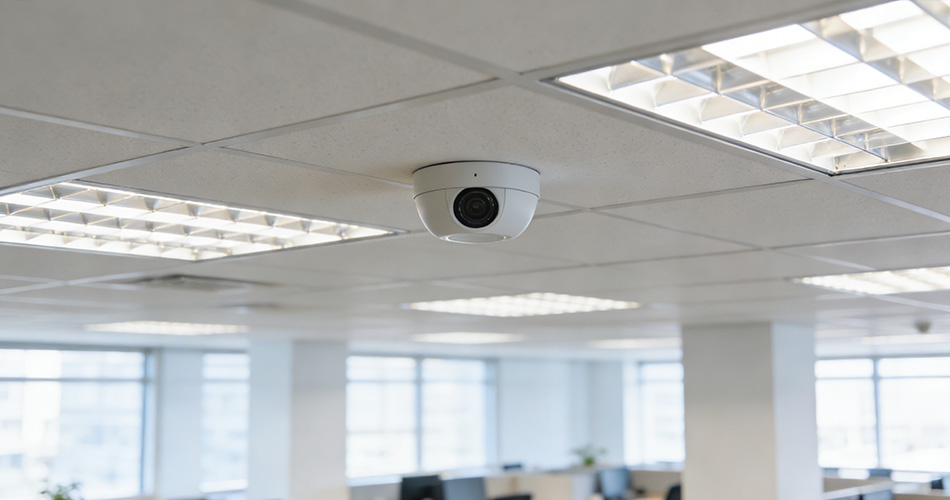
To maximize the effectiveness of office indoor lighting sensors, follow these office-specific implementation guidelines:
Select sensor types based on office zone characteristics: For open plan areas, use multi-zone occupancy sensors to cover individual workstations; for private offices, choose compact, high-precision sensors with ambient light detection; for collaboration zones, opt for sensors with occupancy density sensing capabilities. Avoid one-size-fits-all selection to ensure optimal performance.
Optimize sensor placement and zoning: Install sensors in central, unobstructed locations (e.g., ceiling above workstations, near entryways of private offices) to avoid detection blind spots. Divide large office areas into logical lighting zones (e.g., workstation zones, corridor zones, collaboration zones) and configure sensors to control each zone independently, ensuring precise lighting adjustment.
Integrate with office management systems: Connect sensors to the office’s desk booking software, building management system (BMS), and employee experience platforms. This enables seamless synchronization—e.g., activating lighting for pre-booked workstations, monitoring energy consumption via BMS, and allowing employees to adjust lighting preferences through a mobile app.
Calibrate for employee comfort and energy balance: Adjust sensor sensitivity and dimming parameters based on employee feedback and work patterns. For example, set a longer timeout (10-15 minutes) for focus rooms to avoid frequent on/off triggers during stationary work; set a shorter timeout (5 minutes) for high-traffic corridors. Conduct regular checks to balance energy savings with employee comfort.
Driven by smart office advancements and employee well-being priorities, office indoor lighting sensors are evolving toward greater intelligence and personalization:
AI-driven personalized lighting: Future sensors will integrate AI algorithms to learn individual employee lighting preferences and work habits, delivering tailored illumination automatically. For example, the sensor can remember an employee’s preferred brightness for design work and apply it when they occupy their workstation.
Circadian rhythm synchronization: Sensors will adjust lighting color temperature and intensity throughout the day to align with human circadian rhythms—providing cool, bright light in the morning to boost alertness and warm, dim light in the evening to promote relaxation, reducing employee fatigue and improving sleep quality.
Wireless and low-power deployment: Advances in wireless communication (e.g., Bluetooth, LoRa) and energy-harvesting technology will enable battery-free, wireless office indoor lighting sensors. This simplifies installation and reconfiguration, especially in modular offices where layouts change frequently, reducing maintenance costs.
Wellness-focused sensing integration: Next-generation sensors may integrate with employee wellness devices (e.g., smartwatches) to adjust lighting based on real-time physiological data. For example, if a sensor detects increased eye fatigue via a smartwatch, it will reduce brightness and adjust color temperature to relieve strain.
In conclusion, office indoor lighting sensors are a transformative solution for modern office illumination, addressing the energy waste and one-size-fits-all limitations of traditional systems. Their ability to deliver precise, task-specific lighting, integrate with smart office ecosystems, and support data-driven optimization makes them indispensable for open plans, private offices, collaboration zones, and 24/7 workspaces. By following targeted implementation guidelines—such as zone-specific sensor selection and system integration—facility managers can fully leverage these sensors to reduce costs, enhance employee comfort and productivity, and build sustainable workplaces. As AI and wellness technologies advance, office indoor lighting sensors will become even more integral to employee-centric smart offices, bridging the gap between energy efficiency and human well-being. For anyone involved in office design or management, prioritizing office indoor lighting sensors is a strategic choice to optimize workplace value and create future-proof work environments.
Related news
2026 Commercial Outdoor Lighting System Integration Guide | LumiEasy
Industrial Outdoor Lighting Sensor Guide 2026 | LumiEasy Solutions
Optimize Outdoor Photocell Sensor: Calibration Guide


)
)
)
)

+86 15899791249

+86 755 2955 3313


Address: Huafeng No.1 Science and Technology Park, Sanwei, Bao'an District, Shenzhen, Guangdong, China.
