Time:2026-10-26
📌 Executive Summary for Industrial Managers & OEM Engineers:
Operational Cost Reduction: Implementing automated lighting controls across manufacturing facilities lowers baseline energy consumption by 45% to 70% through dynamic scheduling, daylight harvesting, and occupancy sensing.
Standardized Control Architectures: Modern commercial lighting controls leverage open protocols (such as Bluetooth Mesh, DALI-2, and Zigbee 3.0) to eliminate proprietary vendor lock-in and simplify BMS integration.
Smart Factory Data Fusion: Integrating automatic lighting controls into luminaire-level lighting control (LLLC) frameworks enables real-time power telemetry, heat-mapping, and asset tracking across active production lines.
Global Regulatory Compliance: Advanced lighting control systems satisfy strict building energy codes (ASHRAE 90.1, IECC, and California Title 24), accelerating DLC NLC 5.1 utility rebate approvals.
For industrial facility managers, OEM luminaire engineers, and plant operations directors, managing electrical energy overhead across large-scale manufacturing facilities presents an ongoing challenge. High-bay production halls, assembly lines, and multi-aisle warehouses require high-lux illumination to maintain worker safety and product quality. However, leaving high-wattage LED luminaires running at 100% output in unoccupied zones leads to extreme utility bills, accelerated thermal aging of LED drivers, and unnecessary carbon footprints.
Implementing networked automated lighting controls addresses these operational inefficiencies. By transforming static luminaires into intelligent, data-driven endpoints, factory managers can automate illumination levels based on real-time shift schedules, ambient daylight availability, and worker presence. This technical guide examines system architectures, control types, operational benefits, and key selection criteria for industrial automated lighting setups.
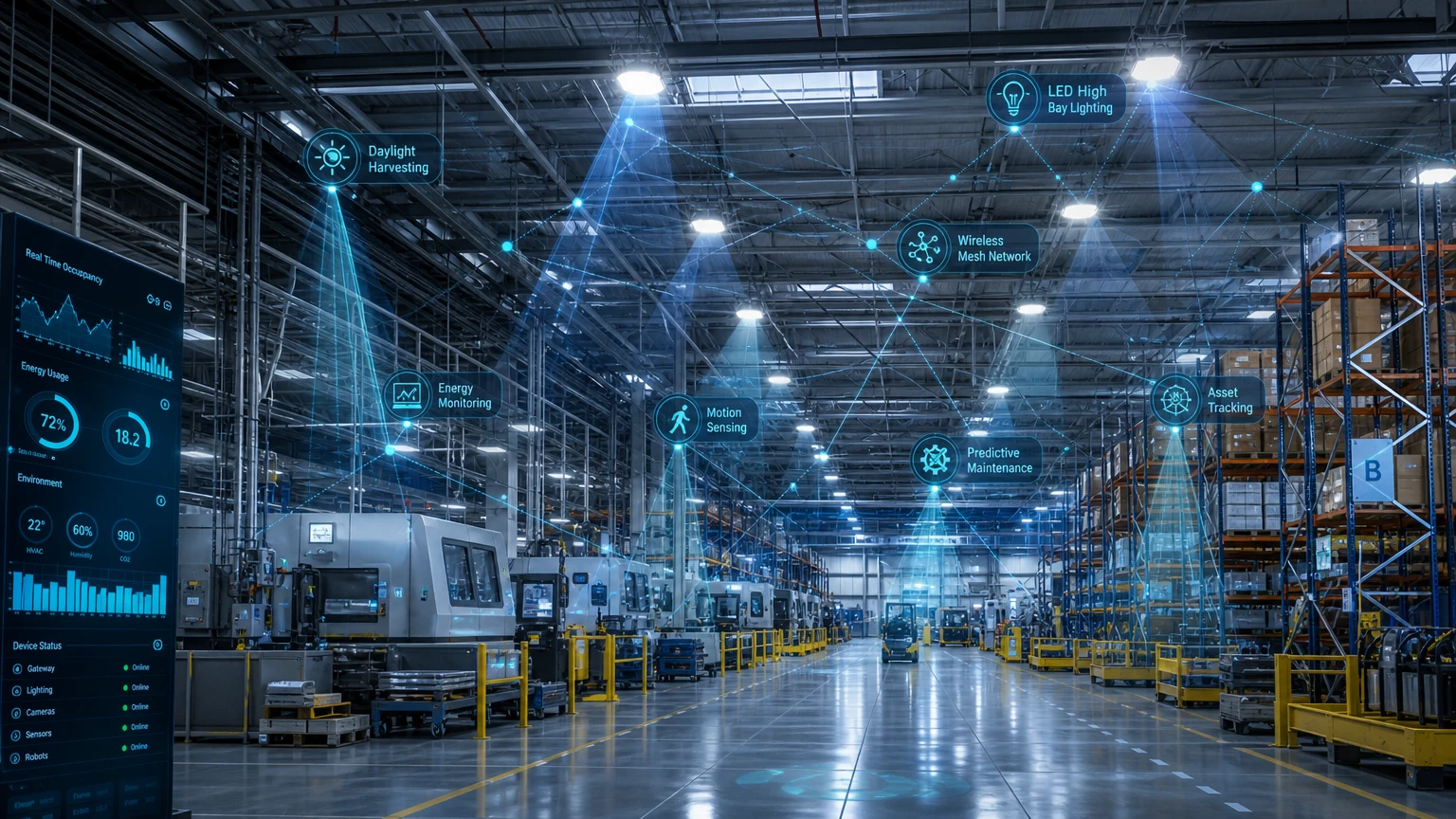
Modern industrial lighting automation extends far beyond simple wall switches or centralized timer relays. Industrial automatic lighting controls rely on a distributed edge-computing topology where individual sensor nodes process inputs locally and transmit status updates over a secure wireless or wired network bus.
In an LLLC architecture, every high-bay or low-bay luminaire contains its own embedded occupancy sensor, daylight photodiode, and wireless radio transceiver. This decentralization eliminates single points of failure. If a central gateway loses connection, each luminaire's automated lighting controls continue operating locally according to pre-programmed logic stored in non-volatile flash memory.
Industrial sensors combine passive infrared (PIR) or microwave motion detection with precise ambient lux measurement:
Dynamic Daylight Harvesting: As daylight enters warehouse skylights or high-elevation factory windows, calibrated photodiode sensors instruct the LED driver to dim output linearly, maintaining constant task-plane illuminance (e.g., 500 lux) while minimizing kWh draw.
High/Low Occupancy Motion Sensing: Rather than completely turning off lights when an aisle is empty—which can create safety hazards or visual discomfort—the system smoothly dims fixtures down to a 10% or 20% standby level, restoring 100% brightness in sub-second response times upon detecting forklift or worker movement.
For a detailed analysis of smart building control frameworks, explore our technical guide on
Selecting the optimal control architecture for commercial lighting controls determines installation speed, cabling costs, and long-term network scalability.
| Engineering Parameter | Wireless Bluetooth Mesh | Wired DALI-2 Bus | Analog 0-10V System |
| System Architecture | Decentralized Wireless Mesh | Two-Wire Digital Bus | Hardwired Voltage Loop |
| Commissioning Method | Smartphone / Tablet App | Desktop PC Software | Physical Dip Switches / Knobs |
| Wiring Requirements | AC Mains Only (No Bus Wires) | 2-Wire Unshielded Control Bus | 2-Wire Low-Voltage Signal Lines |
| Bi-Directional Telemetry | Yes (Power, Lux, Temp, Status) | Yes (D4i Power & Diagnostics) | No (Unidirectional Control Only) |
| Network Scalability | High (Thousands of Nodes) | 64 Short Addresses per Subnet | Limited by Loop Voltage Drop |
| Installation Labor Cost | Low (Minimal Cabling) | Moderate (Control Wiring Required) | High (Extensive Physical Wiring) |
| DLC NLC 5.1 Compliance | Fully Qualified | Fully Qualified (via Gateway) | Ineligible (Requires Module) |
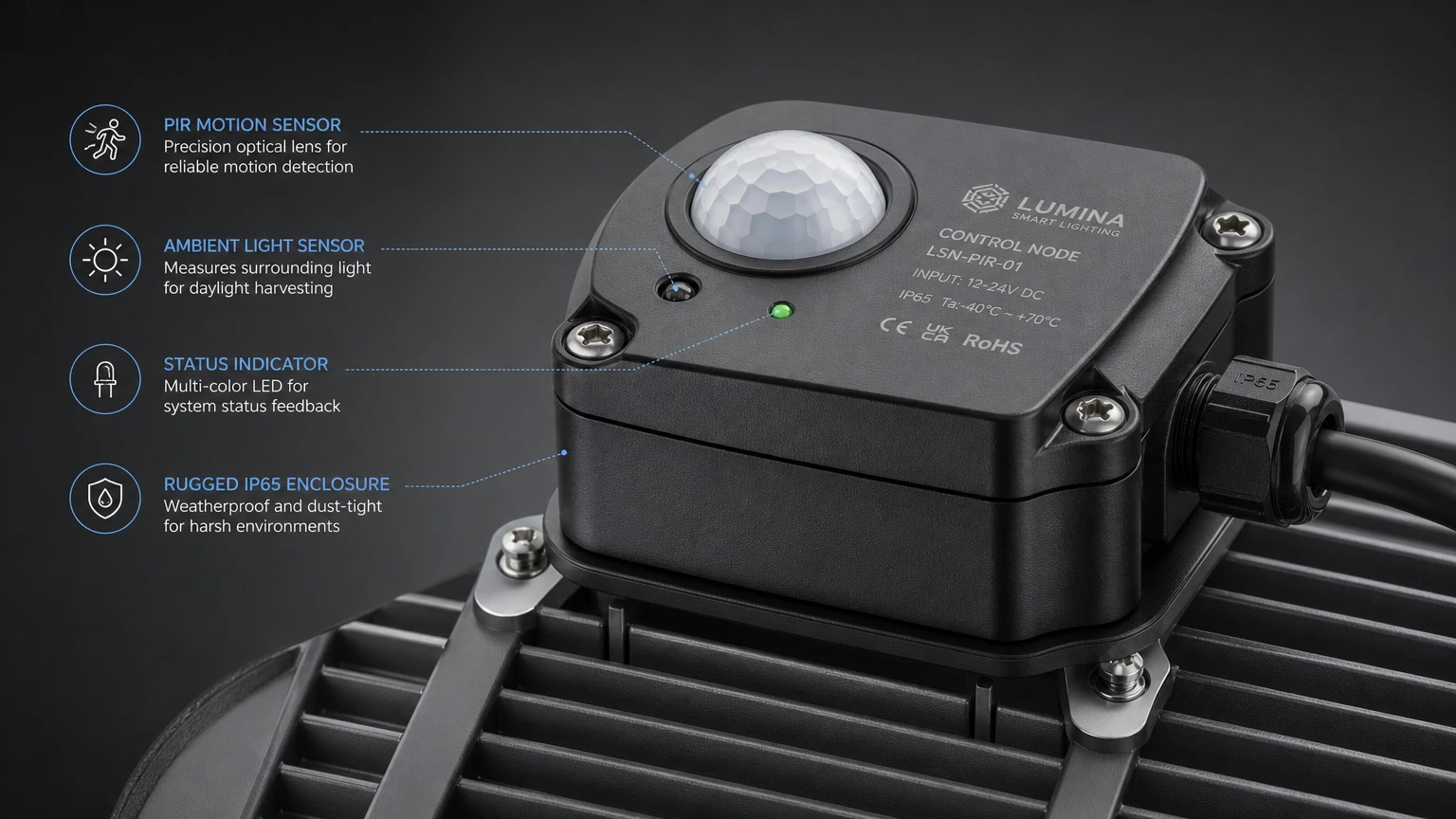
Wireless lighting control systems eliminate control cabling between luminaires. Each fixture acts as a signal repeater, forming a self-healing mesh topology ideal for retrofitting existing production halls without stopping operations or pulling new wires through high ceilings.
Wired digital protocols provide immune bi-directional communication in extreme electromagnetic interference (EMF) environments. D4i-enabled LED drivers provide standardized diagnostic data (energy consumption, operating temperatures, failure codes) directly to the control network.
Deploying networked automated lighting controls delivers measurable operational and financial returns across high-density industrial facilities.
Lighting accounts for 20% to 40% of total electrical energy costs in typical manufacturing facilities. Combining scheduled time-clock events, occupancy-triggered dimming, and daylight harvesting through automatic lighting controls reduces lighting energy consumption by up to 70%.
Facility Energy Reduction Breakdown
Standard LED Upgrade: ~40% Reduction vs. Legacy HID/Fluorescent
Adding Automated Controls (LLLC): +30% Additional Savings via Sensing
Combined Total Efficiency Gain: Up to 70% Overall kWh Reduction
Running LED fixtures at 100% duty cycle continuously accelerates thermal degradation of LED chips and electrolytic capacitors inside driver circuits. By operating luminaires at dimmed states (50%–70% capacity) during non-peak hours, operating temperatures decrease significantly, doubling the effective lifespan of the fixture and reducing maintenance labor for high-bay ceiling repairs.
To understand how automated controls drive productivity on factory floors, read our insights on
Evaluating industrial automated lighting controls requires matching facility requirements against technical capabilities:
Environmental Ingress Protection (IP Rating): Ensure control nodes and sensor pods carry IP65 or IP66 sealing when installed in damp, dusty, or chemical washdown environments.
DesignLights Consortium (DLC) NLC 5.1 Listing: Verify system listing to ensure eligibility for maximum local utility rebates across North America and Europe.
Cybersecurity & Encryption: Require 128-bit AES encryption across wireless network, application, and device layers to protect facility network integrity.
BMS Interoperability: Confirm support for open standard gateways (BACnet/IP, MQTT) to integrate lighting telemetry into broader facility management software.
For further details on global industry trends, consult our comprehensive coverage on
To ensure zero-defect manufacturing when integrating automated lighting controls into commercial luminaires, OEM factories execute a systematic 4-step quality assurance workflow:
| QA Stage | Test Procedure Name | Verification Criteria & Acceptance Standard |
| Step 1 | Optical Sensor & Dimming Curve Test | Verifies motion sensitivity thresholds and closed-loop daylight harvesting dimming accuracy within an automated optical test chamber. |
| Step 2 | Wireless RF Transmit Power & Range Test | Measures 2.4 GHz RF signal strength, RSSI levels, and antenna efficiency to guarantee multi-hop mesh performance across dense steel structures. |
| Step 3 | High-Voltage Isolation & Inrush Test | Evaluates driver inrush current tolerance and high-voltage surge protection to shield microcontrollers from factory electrical grid transients. |
| Step 4 | Unprovisioning & Security Key Reset | Restores control nodes to unprovisioned factory default states, verifying unique QR codes and Bluetooth keys for secure site commissioning. |
A static LED upgrade replaces inefficient traditional lamps with high-efficiency LEDs, reducing energy draw by a fixed percentage whenever the light is turned on. In contrast, automated lighting controls add intelligent sensors, microcontrollers, and communication networks that dynamically adjust light output based on occupancy, schedule, and natural sunlight, yielding an additional 30% to 50% in energy savings.
Industrial-grade wireless control systems operate on robust mesh networking topologies (such as Bluetooth Mesh or Zigbee 3.0). In a mesh network, every mains-powered luminaire acts as both a receiver and a signal repeater. If electromagnetic interference (EMF) from heavy machinery blocks a direct signal path, the network automatically reroutes data packets through adjacent nodes in milliseconds, maintaining reliable control.
In commercial and industrial facilities operating on multi-shift schedules (16 to 24 hours daily), the ROI for deploying automated lighting controls typically ranges between 12 and 24 months. This payback period is accelerated by reduced utility kWh costs, lower maintenance labor for high-bay fixture repairs, and local utility rebate incentives for DLC NLC 5.1 compliant systems.
Upgrading your facility infrastructure or OEM luminaire product lines with advanced automated lighting controls maximizes energy efficiency, ensures code compliance, and creates an intelligent lighting backbone for smart factory operations.
To download technical datasheets, order OEM evaluation samples, or discuss custom control integration with our engineering team,




+86 15899791249

+86 755 2955 3313


Address: Huafeng No.1 Science and Technology Park, Sanwei, Bao'an District, Shenzhen, Guangdong, China.