

Time:2026-07-03
If you are looking for a Silvair compatible sensor supplier, the real question is not just whether the sensor connects. The real question is whether it will work cleanly inside a commercial lighting project, stay easy to commission, and avoid future lock-in.
For facility managers, electrical contractors, building owners, and system integrators, a good Silvair-compatible sensor should do three things well:
Support a standards-based wireless lighting environment
Handle real commercial use cases like occupancy sensing and daylight harvesting
Give your team clear documentation, stable supply, and support during commissioning
At LumiEasy, we see this as a project decision, not just a product decision. The best sensor choice is the one that fits the application, the control standard, and the long-term building strategy.
“Silvair compatible” should mean more than a marketing claim on a datasheet.
In practice, it usually means the sensor is designed to work in a Bluetooth Mesh or Bluetooth NLC-based lighting control environment, where interoperability matters and the project may include devices from more than one vendor. For commercial buildings, that matters because lighting controls are rarely isolated. They often need to work with commissioning tools, retrofit constraints, and sometimes BMS integration.
A truly compatible sensor should help the project team avoid three common problems:
Proprietary lock-in
Commissioning delays
Rework after installation
If a sensor looks good on paper but creates friction on site, it is not a good fit for a commercial project.
Most buyers are not searching for a sensor because they want another hardware box. They are searching because they need a reliable way to deliver control, energy savings, and easier operations.
That usually comes down to one of these project goals:
Reduce wiring and labor in retrofit projects
Add occupancy-based control without rewriting the whole system
Improve daylight harvesting in offices, schools, or retail spaces
Keep the project open enough for future upgrades
Align lighting control with broader building systems
This is where a supplier matters. A supplier should help you match the sensor to the project, not just send you a part number.
If you are evaluating a Silvair compatible sensor supplier, use this checklist.
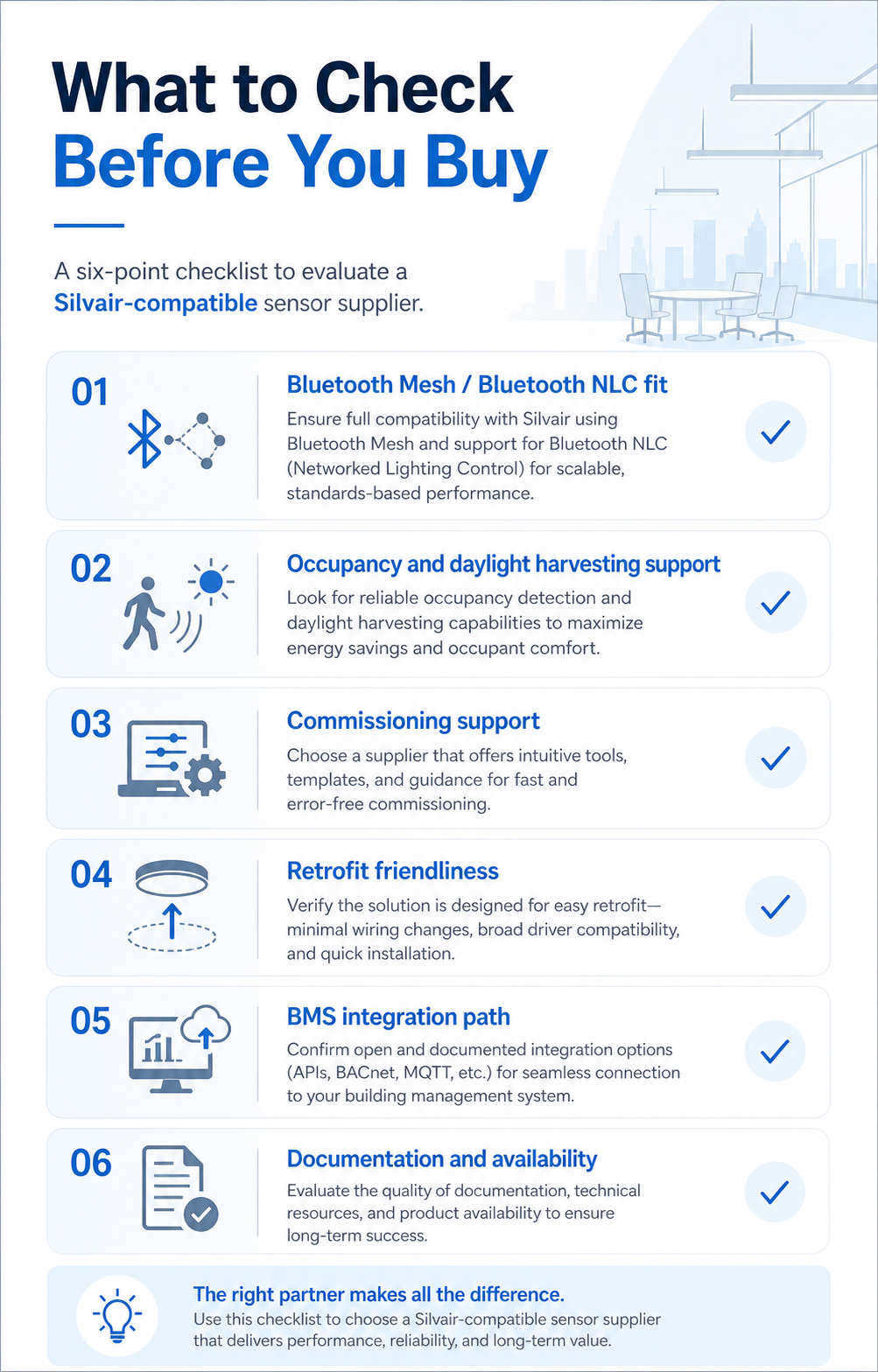
| What to check | Why it matters |
Bluetooth Mesh or Bluetooth NLC fit | Helps the sensor work inside an interoperable wireless lighting environment |
Occupancy and daylight harvesting support | Covers the most common commercial lighting control use cases |
Commissioning support | Saves time on site and reduces setup errors |
Retrofit friendliness | Makes it easier to use the sensor in occupied buildings |
BMS integration path | Helps the lighting system become part of the building’s wider operation plan |
Documentation and availability | Makes approval, procurement, and deployment smoother |
A supplier that can explain these points clearly is usually more useful than one that only repeats the word “compatible.”
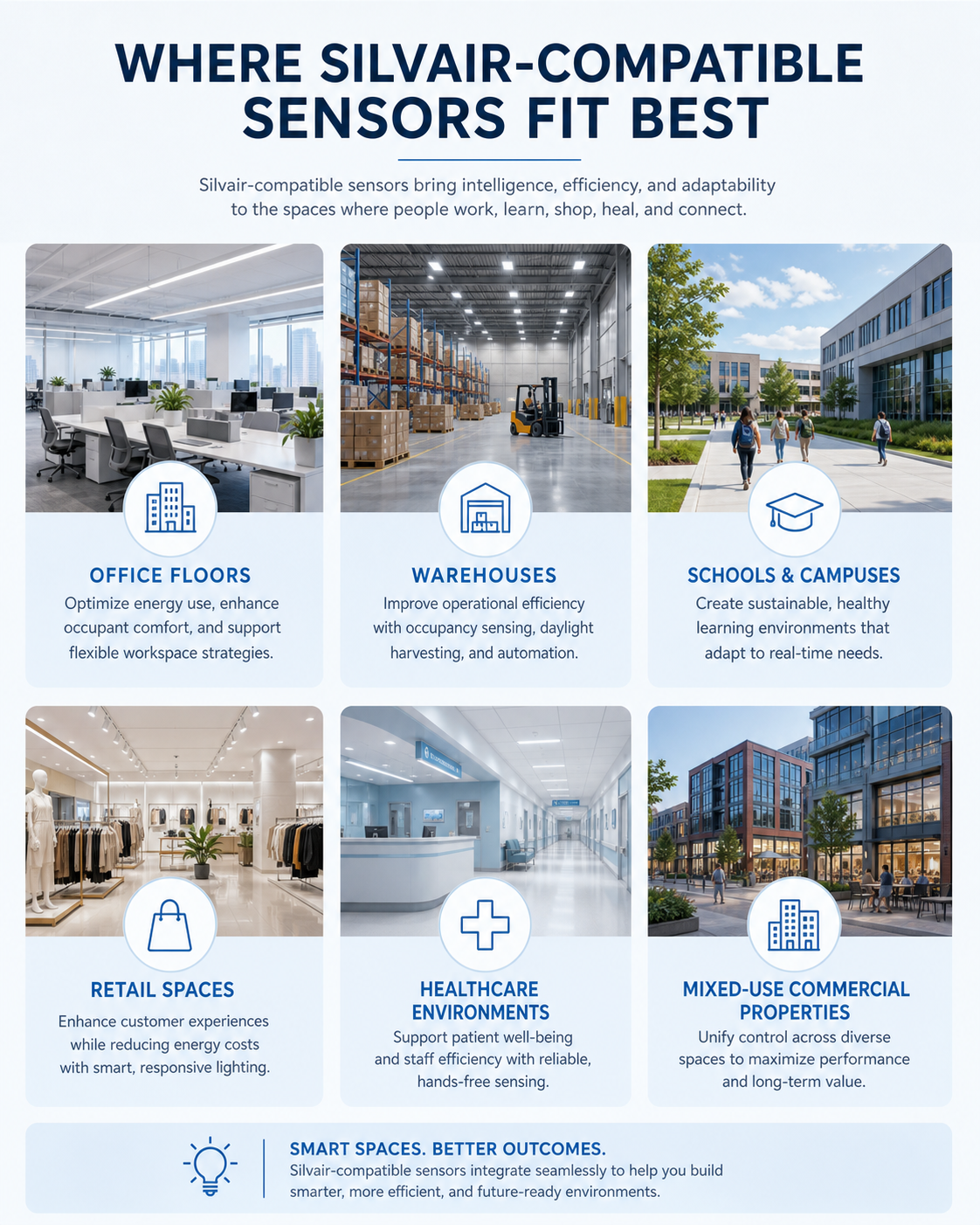
Silvair-compatible sensors are most useful in commercial buildings where lighting has to do more than turn on and off.
Common applications include:
Office floors
Warehouses
Schools and campuses
Retail spaces
Healthcare environments
Mixed-use commercial properties
The most common control functions are occupancy sensing, vacancy sensing, motion sensing, and daylight harvesting. In retrofit projects, those functions can often deliver the fastest payback because they reduce wasted runtime without requiring a full rebuild of the space.
For new construction, the value is different. You get a cleaner control strategy from day one, with better consistency across zones and easier future expansion.
This is the part many buyers underestimate.
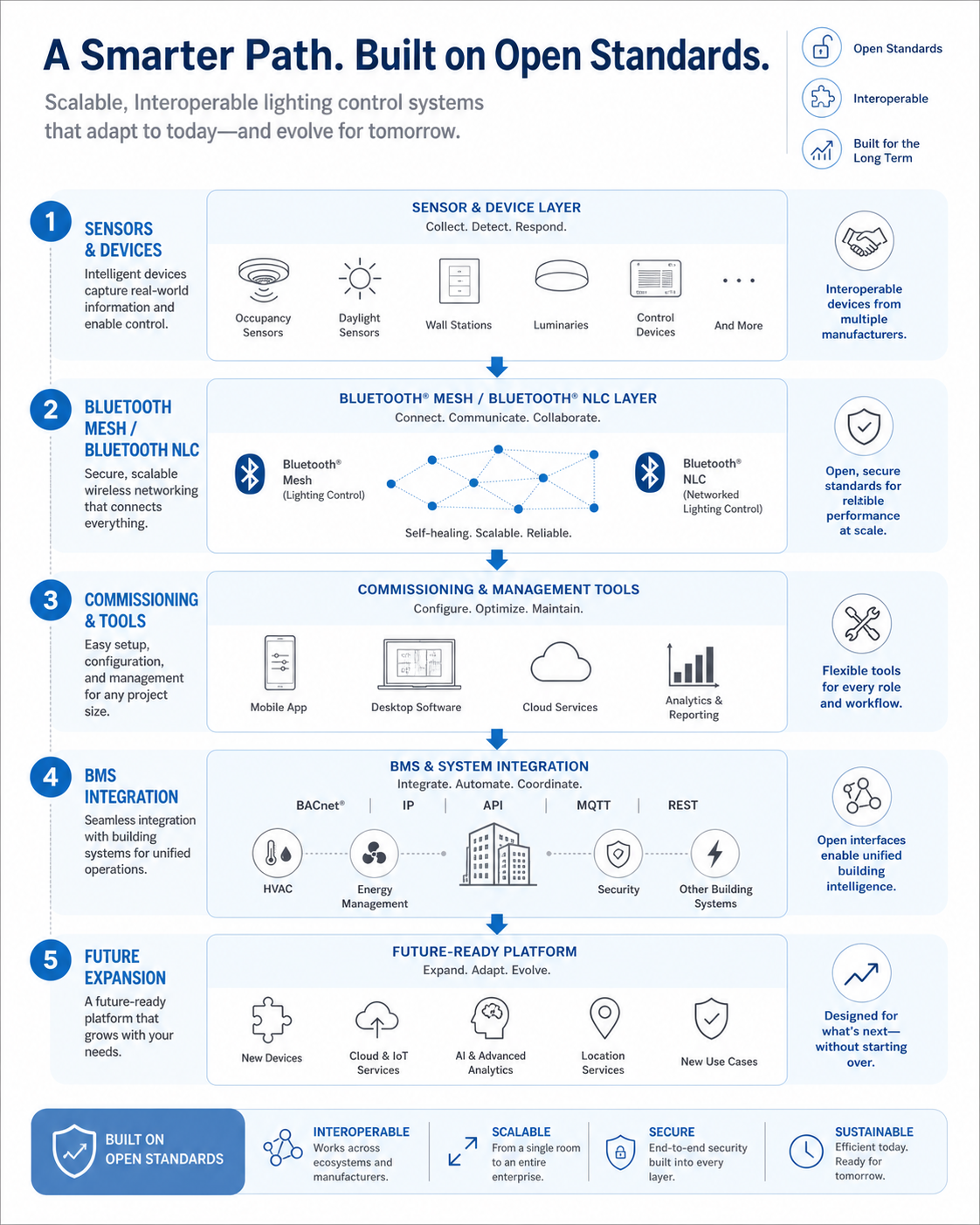
A lighting system built on open standards gives the owner more flexibility later. It reduces the chance that one vendor controls every future decision. It also makes it easier to expand the system, add new spaces, or connect lighting data to other building systems.
Silvair’s public materials place strong emphasis on Bluetooth Mesh, Bluetooth NLC, multi-vendor interoperability, and BMS integration. That is important because the building does not stop at lighting. Owners want lighting data to live alongside HVAC, energy monitoring, and facility management.
If your sensor supplier understands that bigger picture, the project becomes easier to defend internally.
LumiEasy helps commercial teams source Silvair-compatible sensor solutions for real building work, not just product comparisons.
That means we focus on:
Matching the sensor to the use case
Supporting retrofit and new-build projects
Helping specifiers and contractors reduce selection risk
Keeping the buying process clear and practical
If your project needs a sensor for occupancy control, daylight harvesting, or a wireless retrofit plan, LumiEasy can help you narrow the options quickly and avoid devices that look compatible but create headaches later.
For many buyers, that support is the difference between a project that moves and a project that stalls.
Not always. Many projects use Silvair-compatible sensors as part of a phased upgrade, so you can improve lighting control without replacing the entire system.
Yes. Retrofit is one of the best use cases because wireless sensing can reduce wiring work, lower disruption, and speed up installation in occupied buildings.
Choose a supplier that understands the integration path from the start. That makes it easier to connect lighting controls with building systems later without redesigning the project.
Ask for the supported control standard, commissioning flow, functions, documentation, and project references. A real supplier should answer those questions clearly.
Send the project type, building location, new build or retrofit status, required control functions, number of zones or floors, and any BMS or commissioning requirements.
If you want a quick and useful response from LumiEasy, send:
Project type
Building location
New build or retrofit
Desired control functions
Number of zones or floors
Any BMS or commissioning requirements
The clearer the brief, the faster we can recommend a sensor setup that makes sense.
Choosing a Silvair compatible sensor supplier is really about choosing a lower-risk way to deliver commercial lighting control.
The right supplier gives you compatibility, stable performance, and a clean path from installation to commissioning to future integration. That is what commercial projects need.
If you are planning a retrofit, a new build, or a lighting control upgrade, LumiEasy can help you find the right Silvair-compatible sensor solution for the job.
Request a compatibility check
Send your project spec to LumiEasy
Related news
DLC Certified Lighting for Industrial Factory Efficiency | LumiEasy
Wholesale Controller-Compatible Sensors for OEM/ODM | LumiEasy
Wholesale Plug-and-Play Sensors for Industrial Lighting | LumiEasy
Linear BLE Tunable White PIR Senso
NLC-Certified Silvair-Compatible Sensors for Maximum Rebates


)
)
)
)

+86 15899791249

+86 755 2955 3313


Address: Huafeng No.1 Science and Technology Park, Sanwei, Bao'an District, Shenzhen, Guangdong, China.
