

Time:2026-01-29
In modern industrial and office environments, indoor lighting sensors have become essential for enhancing productivity, reducing energy consumption, and enabling automated lighting control. With the rise of smart factories and office automation, more businesses are adopting intelligent lighting solutions that optimize illumination, lower operational costs, and improve employee comfort.
This guide explores indoor lighting sensor types, features, applications, and selection strategies, helping factory and office clients achieve efficient and intelligent lighting automation.
An indoor lighting sensor is a smart device that detects environmental factors such as light intensity or human presence and automatically controls lighting systems, including switching lights on or off and adjusting brightness levels. These sensors can turn off lights in unoccupied areas and automatically adjust brightness when natural light is insufficient, achieving both energy efficiency and automation.
In industrial and office settings, indoor lighting sensors are often integrated with Building Management Systems (BMS) or smart control platforms, providing data collection, remote monitoring, and intelligent decision-making capabilities.
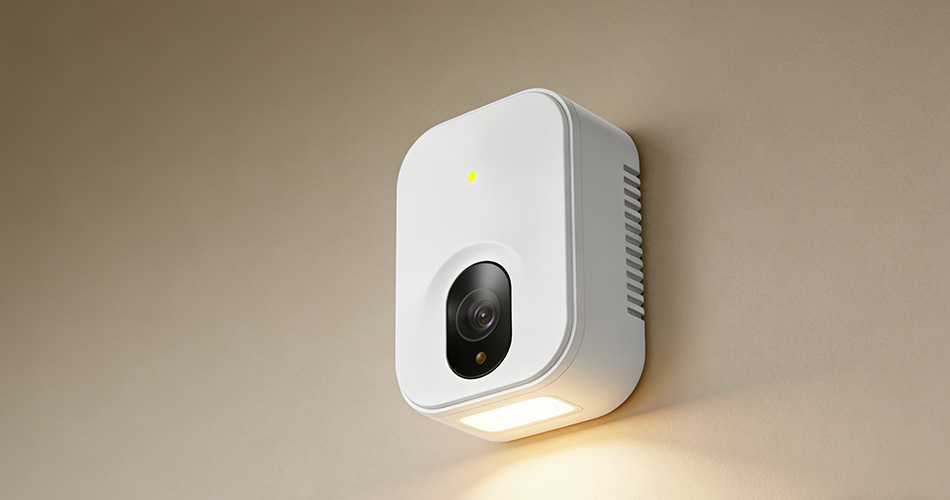
Different types of indoor lighting sensors suit different environments and applications:
Indoor PIR lighting sensors detect infrared radiation emitted by human bodies to determine occupancy and trigger lighting actions. PIR sensors are cost-effective, fast, and reliable, making them ideal for offices, meeting rooms, and warehouses.
Ultrasonic sensors detect motion by sending high-frequency sound waves and analyzing reflections, making them suitable for complex or open spaces. Dual-technology sensors combine PIR and ultrasonic methods to increase accuracy and reduce false triggers.
High-end sensors integrate thermal imaging, microwave detection, and AI algorithms for precise human presence detection and light control, suitable for large factories or areas requiring granular lighting management.
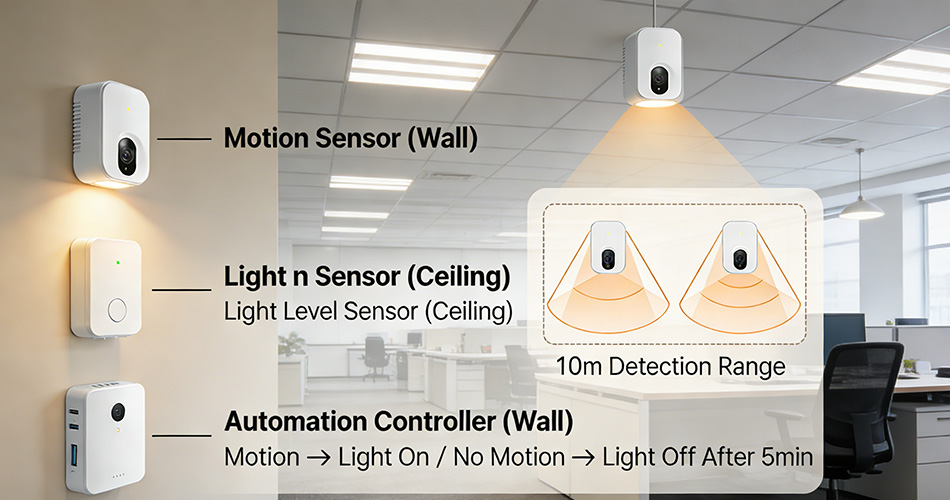
Implementing indoor occupancy lighting sensors brings multiple advantages for industrial and office environments:
Energy Savings and Cost Reduction: Sensors only activate lighting when people are present, reducing energy waste and extending the lifespan of fixtures.
Automation and Convenience: Lights automatically respond to human activity, improving comfort and productivity without manual intervention.
Compliance with Green Building Standards: Many regulations and green building certifications require occupancy-based lighting control systems.
Data-Driven Optimization: Sensor data can be integrated with facility management systems for intelligent lighting strategies and operational efficiency.
Selecting the appropriate indoor lighting sensor range is critical for optimal performance:
PIR Sensors: Typically cover 5–12 meters (16–40 feet) with detection angles up to 180°, suitable for offices, corridors, and small factories.
Ultrasonic and Microwave Sensors: Provide wider coverage for large open areas and reduce blind spots associated with PIR sensors.
Combined Deployment: Multi-sensor arrangements with intelligent algorithms ensure complete coverage, preventing dead zones and improving detection accuracy.
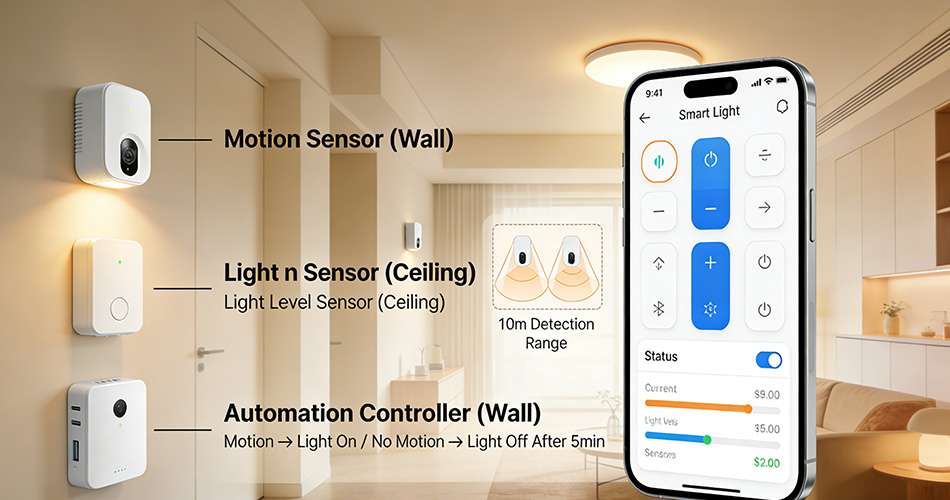
In offices, corridors, and meeting rooms, office indoor lighting sensors automatically control lighting based on occupancy, saving energy while enhancing employee comfort.
In production floors, assembly areas, and storage zones, indoor lighting sensors manage lighting in intermittent or low-occupancy spaces to prevent energy wastage.
Areas such as conference rooms, hallways, storage rooms, and restrooms benefit from intelligent lighting sensors to achieve automated control and energy efficiency.
Assess the Space and Traffic Patterns: Occupancy frequency and layout determine sensor type and placement.
Match Sensor Technology to Environment: PIR sensors are ideal for enclosed spaces, while ultrasonic or dual-technology sensors suit open areas.
Optimize Sensor Placement: Install sensors above entrances, hallways, and work zones for optimal coverage.
Adjust Sensitivity and Delay Settings: Fine-tune sensitivity and off-delay times to reduce false triggers and maximize efficiency.
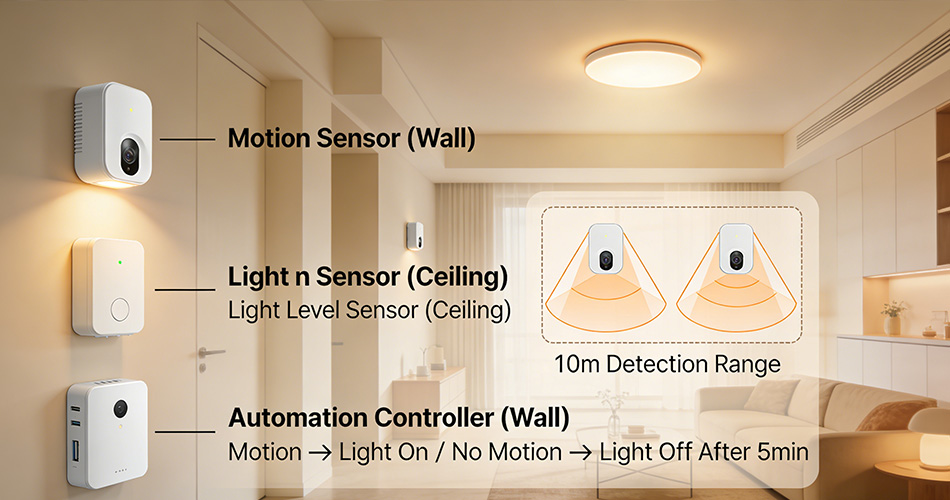
Q1: What is an indoor occupancy lighting sensor?
A: An indoor occupancy lighting sensor is a smart device that automatically controls lights based on human presence, providing energy savings and convenience.
Q2: Where are indoor PIR lighting sensors most suitable?
A: Indoor PIR lighting sensors are ideal for small to medium-sized enclosed or semi-enclosed areas such as offices, meeting rooms, and warehouse corridors, offering fast response and low cost.
Q3: What is the typical indoor lighting sensor range?
A: Indoor lighting sensor range depends on sensor type. PIR sensors generally cover 5–12 meters, while ultrasonic or microwave sensors can cover larger areas.
Q4: How much energy can office indoor lighting sensors save?
A: Office indoor lighting sensors can reduce energy consumption by 20–50% by automatically switching lights based on occupancy, significantly lowering operational costs.
Q5: How should I choose the right indoor lighting sensor for a factory?
A: Choose an indoor lighting sensor based on space size, human traffic patterns, and control requirements. PIR is suitable for smaller enclosed areas, ultrasonic or dual-technology sensors are better for large open spaces, and multi-sensor setups can ensure full coverage.
Related news
Wholesale Controller-Compatible Sensors for OEM/ODM | LumiEasy
Commercial Smart Lighting Cost Analysis: Unlocking Long-Term Savings for Businesses
Industrial Smart Lighting Maintenance: Essential Guide for Efficiency & Longevity
Commercial Smart Lighting Solutions for Energy-Saving Buildings
Scalable Smart Lighting Solutions Grow With Your Commercial Success


)
)
)
)

+86 15899791249

+86 755 2955 3313


Address: Huafeng No.1 Science and Technology Park, Sanwei, Bao'an District, Shenzhen, Guangdong, China.
